
By Rachel Bennett April 6, 2026
Payment acceptance costs have moved from a back-office concern to a front-line business issue. For many merchants, rising card usage means more convenience for customers, but it also means more pressure on margins.
When more customers tap, dip, click, and pay with rewards cards, the cost of accepting those payments can quietly add up across every transaction.
That is why more business owners are taking a closer look at cash discounting vs surcharging Washington strategies. Both models are designed to help offset card-related costs, but they do not work the same way, and they do not feel the same to customers.
One presents a card price and offers a discount for cash. The other adds a fee when a customer uses a credit card. On paper, the difference may sound small. In practice, it can shape trust, pricing perception, staff workflows, checkout conversations, and even repeat business.
For WA businesses, the decision is not just about recovering costs. It is also about customer fit, retail pricing transparency, signage, operational consistency, and compliance habits. A model that works well for a convenience store may feel awkward in a medical office. A strategy that helps one merchant protect margins may create friction for another.
This guide explains the real-world cash discount vs surcharge differences, how each approach affects customer experience, what Washington surcharge laws and practical compliance concerns mean in daily operations, and how to choose the right fit for your customer base. It is for educational purposes only and should not be treated as legal or tax advice.
Why More WA Businesses Are Comparing Cash Discounting and Surcharging
Merchants across Washington are under pressure from several directions at once. Product costs, labor expenses, rent, insurance, and software subscriptions continue to compete for the same dollars.
At the same time, customers increasingly expect fast, flexible card payments, contactless checkout, online invoicing, and digital wallets. Those payment options can help sales, but they also raise the business’s cost of acceptance.
That is where merchant fee recovery options come into the conversation. Instead of simply absorbing every processing charge, businesses are exploring ways to handle payment processing fees Washington merchants face without damaging the customer relationship.
For some, that means adjusting menu prices or service pricing across the board. For others, it means more targeted card payment pricing strategies like surcharging or cash discounting.
The challenge is that customers do not experience these models the same way merchants do. A business owner may see a few percentage points of cost recovery.
A customer may see a surprise fee, a reward for using cash, or a price that feels inconsistent with what they expected. That gap matters. Even when the math works, poor implementation can trigger complaints, disputes, negative reviews, or a sense that pricing is not transparent.
Washington businesses also have to think about the local customer mix. A downtown coffee shop serving fast-moving card-heavy traffic will face different consumer payment preferences than an auto repair shop where customers are already used to larger invoices and detailed breakdowns.
A neighborhood market with a strong cash-paying base may view a cash discount program WA businesses can use as a natural fit, while a professional office may prefer a simpler, more formal pricing structure.
What Cash Discounting Means in Everyday Business Terms
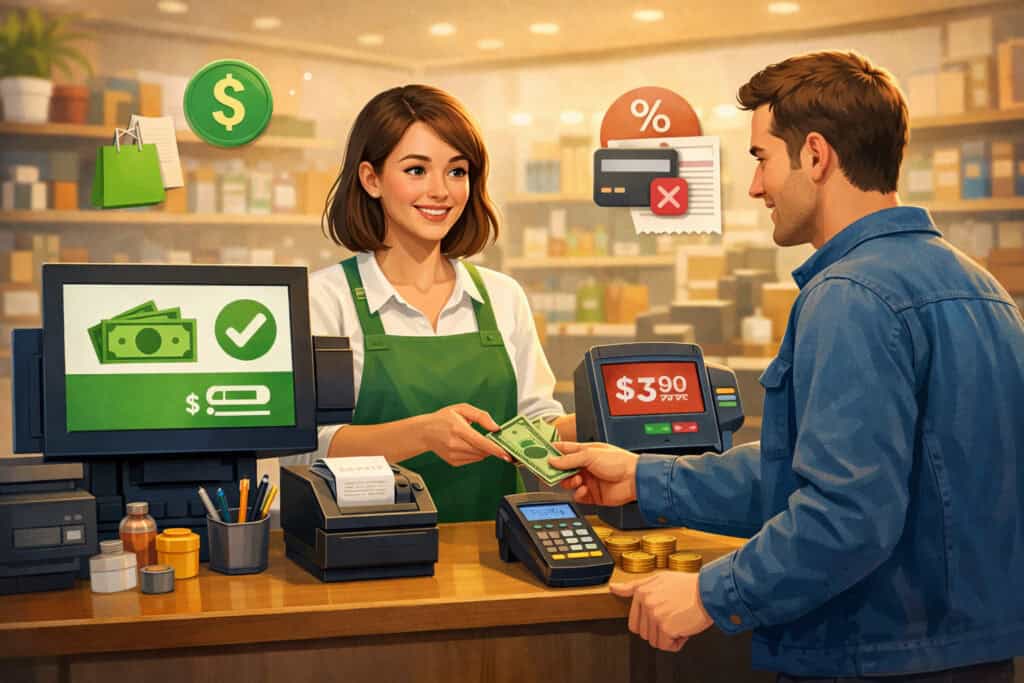
Cash discounting is often easier to understand when you look at it from the customer’s side. In a typical cash discount setup, the business posts the regular price as the card price.
Customers who pay with cash receive a discount from that posted amount. In other words, the listed price is not increased at checkout for card users. Instead, a lower price is available to cash-paying customers.
This distinction matters because cash discounting is built around a discount model rather than a fee model. That can make the customer conversation feel different. Instead of saying, “There is an extra charge for using a card,” the message is, “You can save if you pay with cash.” For some businesses, that feels more positive and less confrontational.
A well-structured cash discount program also depends on clear execution. The posted price must be accurate, signage must explain that a discount is available for cash, receipts should show the pricing clearly, and staff should be able to explain it in one or two calm, consistent sentences. If any part of that breaks down, the program can feel misleading rather than helpful.
Cash discounting tends to appeal to merchants who want to encourage lower-cost payment methods without making customers feel directly penalized for using a card. It can be especially attractive in businesses where cash still plays a meaningful role and where speed of explanation at the register matters.
How Cash Discounting Is Presented to Customers
Customer perception starts with what they see first. In a cash discount environment, the menu board, shelf tag, service menu, or invoice generally reflects the standard price. Then the business offers a discount when the customer pays with cash. That may sound straightforward, but presentation is everything.
If the signage is unclear, customers may think the listed price is the cash price and the higher card total is a surprise add-on. That confusion can create the same frustration associated with poorly implemented surcharges.
The merchant may believe they are running a compliant discount model, but the customer only experiences a mismatch between the advertised and final amount.
The best cash discount setups make the flow obvious. The posted price is visible. The cash savings is disclosed before payment. The receipt supports the explanation. Staff use the same language every time. This improves retail pricing transparency and helps customers feel informed instead of cornered at the terminal.
Businesses also need to think about the environment. In fast-service retail, customers need immediate clarity. In invoice-based businesses, the explanation may need to appear on estimates, payment links, and final bills.
A cash discount model works best when pricing communication is built into every step, not left to a last-second verbal explanation.
Where Cash Discounting Often Works Best
Cash discounting often works best where customers are already familiar with price variation based on payment method or where cash remains common enough to feel normal.
Convenience stores, neighborhood markets, certain quick-service food businesses, tobacco retailers, and some specialty merchants often find that customers understand the model quickly when it is explained well.
It can also make sense in service environments where there is room for a brief explanation before payment. For example, a small repair business or local contractor may present a card price and explain that there is a discount for cash or check. In those settings, the customer often has more time to process the pricing and less expectation of one-click simplicity.
Another benefit is that cash discounting can reduce the emotional sting some customers feel with an explicit credit card surcharge Washington State merchants may apply in a compliant setup.
Psychologically, people often respond better to the idea of earning a discount than paying a penalty. That does not mean every customer will prefer cash discounting, but it can reduce tension at checkout.
The model is less ideal when a business has almost no cash transactions, when customers strongly expect one clear all-in price, or when staff turnover makes consistent explanation difficult. In those cases, even a legitimate cash discount program can become messy in execution.
What Surcharging Means and Why Some Businesses Prefer It
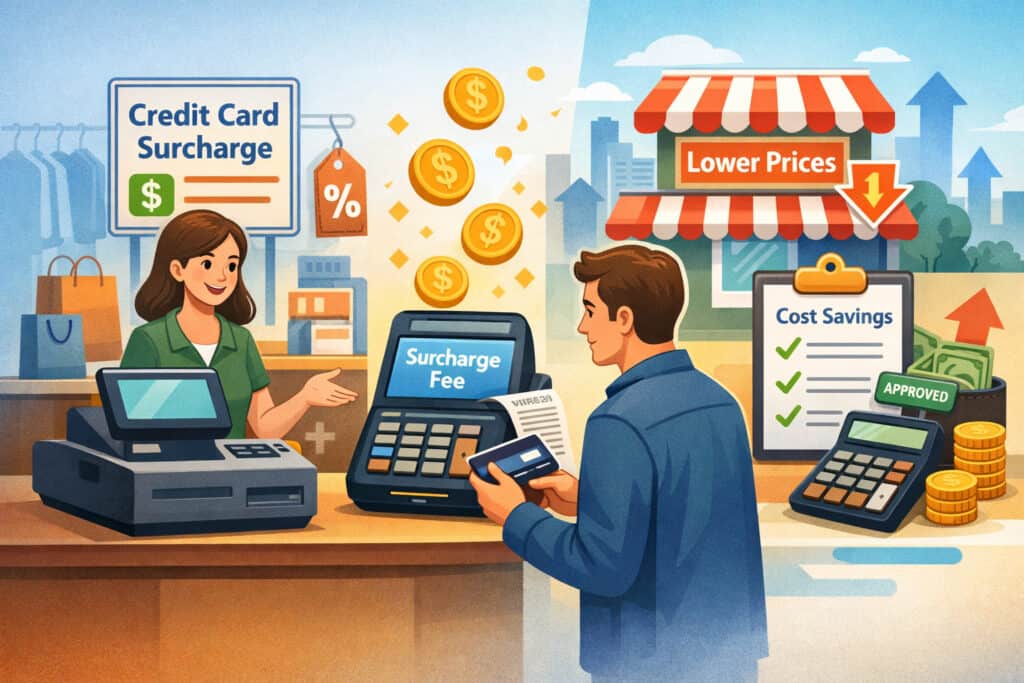
Surcharging takes a different approach. Instead of posting a standard price and offering a discount for cash, the business adds a fee when a customer pays with a credit card.
The key word there is credit. In most compliant surcharge programs, debit and prepaid cards are treated differently and generally are not subject to the surcharge, even if processed without a PIN.
For merchants, surcharging can feel more direct. Rather than redesigning pricing around a discount framework, it allows the business to keep its base price and then recover some of the payment acceptance costs tied to credit card use. That can appeal to businesses that want cost recovery to be visible and attributable to the payment choice itself.
The appeal of surcharging is often strongest where card processing costs are substantial, average ticket sizes are larger, and cash volume is low.
If only a small share of customers pays cash anyway, a discount-driven program may not do much to change payment behavior. In that setting, a surcharge may feel more practical because it addresses the cost where it occurs.
But the tradeoff is customer reaction. Some buyers see a surcharge as fair. Others see it as nickel-and-diming, even if the fee is disclosed.
That reaction can vary by industry, customer demographics, and checkout environment. A well-executed surcharge program can be accepted without much friction. A poorly explained one can create immediate distrust.
How Surcharging Is Different From a Cash Discount
The cleanest way to understand cash discount vs surcharge differences is to focus on the advertised price and the customer’s final bill. With a surcharge, the advertised or quoted price is generally the price before the additional credit card fee.
If the customer chooses to pay with a credit card, the surcharge is added to the transaction. With cash discounting, the posted price is usually the standard card price, and a reduction applies for cash.
This difference changes how customers interpret pricing. A surcharge can feel like an add-on. A cash discount can feel like a reward. Those are not just language differences. They shape how transparent, fair, and intentional the pricing feels.
The operational differences matter too. Surcharging often requires careful system settings so the fee is applied only where appropriate, especially when distinguishing credit from debit.
That means the POS, gateway, invoicing platform, and receipts must all work correctly. Cash discounting also requires system support, but the customer-facing message is usually built around a discount rather than a fee line.
There is also a tax and recordkeeping angle. In Washington, businesses need to be careful about how added charges are treated and reported.
This is one reason businesses should review the structure with qualified advisors before launching any fee recovery model. A strategy can make sense commercially but still create accounting or compliance problems if it is configured casually.
When Surcharging May Feel More Natural to the Customer
Despite the emotional resistance some consumers have to fees, surcharging can feel natural in some environments.
Professional services, B2B vendors, invoice-based businesses, contractors, legal services, property-related services, and certain repair businesses may have customers who are less focused on impulse pricing and more focused on payment method choice. In those cases, a clearly disclosed fee for paying by credit card may be accepted as part of the transaction.
Surcharging can also work better where customers expect line-item detail. If a client is already reviewing labor, parts, tax, travel, and service charges, an additional credit card fee may not feel especially unusual. The context matters. In a service-based invoice, buyers often process fees differently than they do at a retail counter or restaurant register.
This model may also be easier for businesses that want to keep a single primary price structure while recovering some costs only from the transactions that generate them. If almost everyone pays by card, a cash discount program may have little behavioral effect. A surcharge directly connects the cost of credit acceptance to the card-paying transaction.
That said, even in surcharge-friendly industries, communication matters. Customers usually react badly when the fee appears at the last second, when it is explained inconsistently, or when the advertised amount feels incomplete. A surcharge should never feel buried.
Cash Discounting vs Surcharging Washington: The Core Differences at a Glance
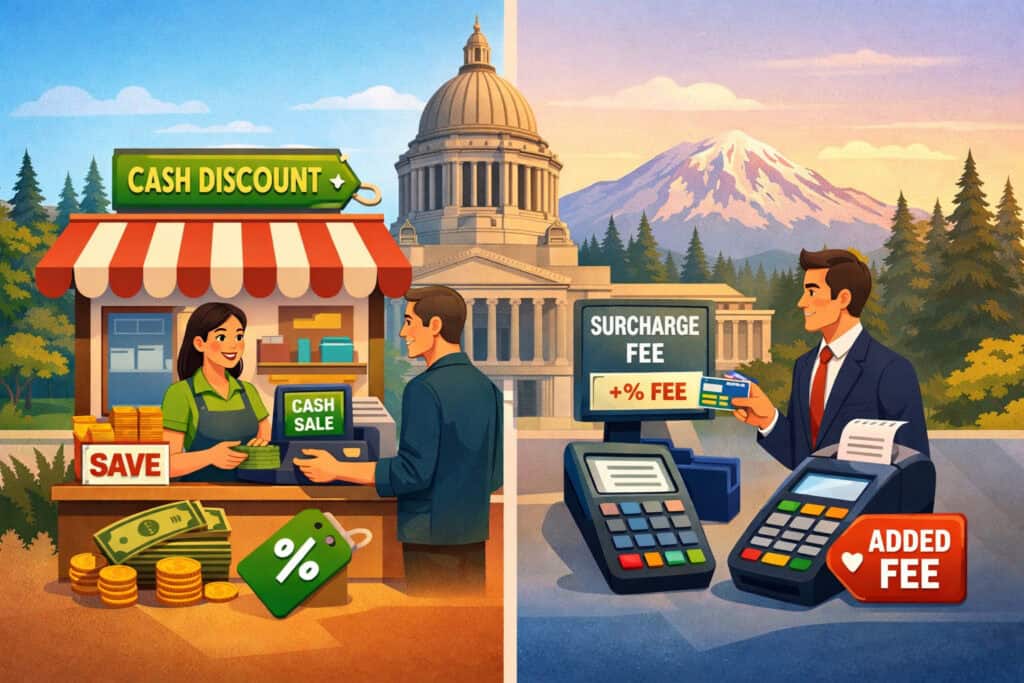
When WA merchants compare these models, they usually start with one question: which one saves more money? That is important, but it is not enough. The better question is which one fits your customer base, pricing style, staff capacity, and compliance discipline.
Below is a practical comparison table to help frame the decision.
| Factor | Cash Discounting | Surcharging |
| Basic structure | Posted price reflects standard card price; cash customers receive a discount | Base price remains, and a fee is added when a customer uses a credit card |
| Customer perception | Often feels like a reward for cash use | Often feels like an extra charge for card use |
| Best fit for | Businesses with meaningful cash volume or price-sensitive in-person buyers | Businesses with low cash volume, larger tickets, or invoice-based payment flows |
| Pricing presentation | Requires very clear messaging that cash gets a lower price | Requires very clear disclosure that credit card use triggers a fee |
| POS and receipt setup | Must show discount clearly and consistently | Must apply fee correctly and distinguish eligible card types |
| Staff explanation | “You save when you pay cash” | “There is a fee for credit card payments” |
| Risk of customer frustration | Confusion if posted prices and final totals do not match expectations | Frustration if the fee feels hidden or appears late in checkout |
| Compliance focus | Signage, posted prices, receipt clarity, program structure | Signage, notice, fee caps, receipt clarity, card-brand requirements |
| Operational advantage | Can reduce perceived negativity | Can directly connect cost recovery to credit transactions |
The table helps, but the deeper issue is fit. Two businesses with similar sales volume can reach opposite conclusions based on customer expectations alone. A retail store competing on advertised shelf prices may choose differently than a service firm that sends invoices and receives card payments after work is complete.
The Business Case for Each Model: Margin Protection, Cost Recovery, and Simplicity
At the business level, both models are trying to solve the same problem: card costs are real, and somebody has to absorb them. The difference is where that burden sits and how visible it becomes.
Cash discounting supports margin protection by encouraging lower-cost payment methods and setting a price structure that does not feel like a fee-first approach.
It can be appealing for merchants who want to preserve pricing flexibility while avoiding the optics of a direct surcharge. It may also align well with stores that still see a healthy amount of cash and want to keep that option alive.
Surcharging supports cost recovery more directly. Rather than rewarding cash, it allocates part of the cost to credit card transactions themselves. For businesses where credit cards dominate, this can feel more efficient. It also keeps the logic simple internally: if a payment type costs more, that payment type carries the additional charge.
Operational simplicity can cut both ways. Some merchants think surcharging is easier because it is direct. Others find cash discounting easier because the customer message is softer. The true answer depends on your systems.
If your POS cannot clearly separate card types or print receipts the right way, a surcharge program can become risky fast. If your pricing displays and shelf tags are hard to update consistently, cash discounting can become confusing.
The best choice is usually the model that your staff can execute accurately and your customers can understand quickly. Margin recovery matters, but consistency matters just as much.
How Ticket Size and Card Mix Influence the Choice
Average ticket size is one of the most overlooked variables in this decision. A small surcharge on a modest purchase may not seem meaningful to the merchant, but customers often notice any fee on low-ticket transactions because it feels immediate and visible.
On a cup of coffee, snack, or quick convenience purchase, even a small added charge can feel irritating out of proportion to the amount.
On the other hand, in higher-ticket settings, the fee can become large enough to meaningfully affect customer behavior.
In auto repair, home services, specialty retail, or professional offices, a surcharge on a large invoice may push some customers toward ACH, check, or cash alternatives. That can be useful if the business wants to lower acceptance costs, but only if the payment process remains smooth.
Your card mix matters too. If almost every customer pays with a card, then a cash discount program may have limited practical impact unless customers are willing to change payment behavior. If cash usage is already meaningful, the discount model may reinforce a habit that helps your margins naturally.
Merchants should also review card brand mix. Premium rewards cards often carry higher processing costs, which can make the fee recovery conversation feel more urgent. But that does not automatically mean surcharging is the answer. The right model still depends on how customers respond in your particular setting.
How Customer Perception Changes the Real Cost of Each Model
The visible processing fee is only one part of the cost story. The less visible cost is customer reaction. That reaction can affect loyalty, review sentiment, staff stress, and dispute rates. A merchant that recovers fees but loses repeat business has not really solved the problem.
Customer perception is shaped by more than the amount charged. Timing matters. So does language. A fee presented early and explained professionally may be accepted. The same fee revealed after the card is inserted can feel deceptive. A cash discount explained on signage and receipts can feel fair. The same structure, if buried in tiny print, can feel manipulative.
This is why retail pricing transparency matters so much in both models. People do not like surprises around money. They especially do not like feeling that the “real” price appeared only after they committed to buying. The fastest path to frustration is any mismatch between advertised and final price that the customer did not reasonably expect.
Businesses should treat customer communication as part of the math. If your market is highly competitive and buyers compare every visible price, you need a model that protects margins without making your business feel harder to buy from than the place next door.
Customer Expectations and Buying Behavior Matter More Than Most Merchants Think
Many businesses choose a pricing model based on what seems fair internally. That is understandable, but it is not always how customers make decisions. Buyers respond to context, habit, and ease. What they are used to in one type of business may feel jarring in another.
For example, in fast-casual retail or food service, customers usually expect the price on the board, shelf, or menu to feel final apart from tax. Extra payment-related charges can slow down the line and create mini-negotiations at the counter.
In contrast, customers reviewing a detailed invoice for a repair or professional service may be more open to a fee tied to payment method, especially if lower-cost alternatives are offered.
Local competition also shapes expectations. If nearby businesses absorb card costs and advertise straightforward pricing, a visible surcharge can make your business feel more expensive even when the total difference is small.
If several competitors already use discount or surcharge models, customer resistance may be lower because the concept is familiar.
Payment behavior is not only emotional. It is practical. Some customers rarely carry cash. Others prefer to avoid card fees and will switch to debit, ACH, or check if the options are presented clearly. That makes consumer payment preferences one of the most useful inputs when comparing models.
Why Some Customers Accept One Model and Reject the Other
People do not react to pricing models purely rationally. Two approaches that produce the same net payment can feel completely different because of framing. A customer may object strongly to a surcharge but happily take a cash discount, even if the economic result is similar. That is because the first feels like a penalty and the second feels like a choice.
Trust also matters. When customers understand the pricing before they decide how to pay, they are more likely to accept it. When they discover it late, they are more likely to feel tricked. In many cases, the issue is not the amount itself but the feeling that information was withheld.
There is also a difference between essential and discretionary purchases. Customers buying urgent repairs or necessary services may tolerate fees more than customers making impulse retail purchases. Likewise, loyalty matters. Regular customers who know your business may accept a new policy more easily than first-time shoppers comparing multiple options.
That is why businesses should not copy a pricing model just because it worked for another merchant. The same policy can land very differently depending on customer relationship, shopping environment, and how emotionally sensitive the purchase is.
How Buying Speed Changes What Customers Will Tolerate
Buying speed is one of the most practical filters for choosing between card payment pricing strategies. In a high-speed environment, customers have very little patience for explanations. The more your checkout depends on quick decisions, the more dangerous confusing payment pricing becomes.
Convenience stores, quick-service counters, food trucks, and busy retail lines benefit from simplicity. Customers want to know the total, tap, and move on. If they need to stop, ask questions, or rethink the purchase because of a payment-related fee, even a small issue can create a bottleneck and affect the mood of the line.
In lower-speed environments, there is more room for conversation. An office manager paying an invoice, a customer settling a repair bill, or a patient reviewing a statement may be more willing to process fee-related information. That does not remove the need for clarity, but it changes the tolerance level for pricing detail.
As a rule, the faster the checkout, the more your pricing model needs to be instantly understandable. If customers need a script to decode it, it is probably too complicated for that setting.
Which Model Fits Different Types of WA Businesses?
No single answer works across industries because the customer journey changes from one business type to another. The right choice often depends on how prices are displayed, how long customers spend deciding, and what payment methods they already expect to use.
Retail businesses often need the highest level of visible price clarity. Shelf tags, promotional displays, and advertised offers create expectations before checkout.
A model that changes the final total in a way customers did not anticipate can undermine trust quickly. That does not mean retail cannot use cash discounting or surcharging, but it does mean execution has to be exceptionally clean.
Restaurants face their own complications. Customers evaluate menu prices emotionally, and dining involves service, tax, and often tipping. Adding another pricing layer can be tricky. A cash discount may be easier for some counter-service concepts than for full-service restaurants where guests expect a straightforward payment experience after the meal.
Service businesses, repair shops, professional offices, and specialty merchants may have more flexibility because customers often review estimates, invoices, or work orders before paying. In those settings, there is more room to explain pricing and offer alternatives like ACH, check, debit, or cash.
Retail, Convenience, and Specialty Merchants
Retail and convenience businesses tend to succeed with whichever model creates the least friction at the register.
For many, that means carefully evaluating whether the customer base is cash-friendly enough to support a cash discount program WA businesses can run consistently. If a noticeable share of buyers already uses cash, the discount model may feel natural and even appreciated by price-sensitive shoppers.
For card-heavy retail, a surcharge can be harder to manage from a customer-experience standpoint. Shoppers compare sticker price, not just final price. If the checkout total exceeds what they expected because of a card fee, they may not care that the fee is technically disclosed. They may simply decide the store feels more expensive than alternatives.
Specialty merchants vary. A niche retailer with high average tickets and strong product differentiation may have more room to use a transparent surcharge model.
A highly competitive retailer selling common items may have less. In convenience settings, speed and familiarity matter most, which often pushes merchants toward the model that requires the fewest explanations.
Retailers also need to think carefully about online reviews. Price surprises are among the fastest triggers for negative feedback, especially when buyers feel the fee should have been built into the displayed price.
Restaurants, Service Businesses, Professional Offices, and Auto Repair
Restaurants need to be especially careful because the payment experience is part of the overall hospitality impression. In quick-service environments where signage is strong and customer expectations are clear, a cash discount may work reasonably well.
In full-service dining, adding payment complexity at the end of the meal can feel off-brand unless the communication is exceptionally polished.
Service businesses often have more room to use surcharging because the customer interaction is already more consultative.
A salon, contractor, consultant, repair business, or invoice-driven service provider may be able to explain that credit card payments carry a fee while other payment methods do not. That structure can feel logical if it is disclosed before payment, not after the fact.
Professional offices need to consider tone and trust. Medical, legal, accounting, and similar firms often depend on credibility and low-friction billing. Some may prefer to absorb fees or steer customers to other payment methods rather than make the card fee too visible. Others may find that a carefully disclosed surcharge works because clients are used to paying by invoice.
Auto repair is one of the clearer examples where model fit depends on ticket size and urgency. On a large invoice, a surcharge may push some customers to debit, check, or cash. But because the amounts are larger, the explanation has to be very clear up front to avoid a stressful surprise during pickup.
Compliance, Disclosures, Signage, and Operational Consistency
Compliance is where many pricing strategies stop being theoretical and start becoming real operational work. Whether a business uses surcharging or cash discounting, the legal and card-brand landscape is not something to treat casually.
Washington businesses need to think about Washington surcharge laws, card network requirements, tax treatment, system configuration, and general consumer-protection standards around clear pricing and fair disclosure.
The key point is that “allowed” does not mean “safe if done sloppily.” A model may be generally available, but poor implementation can still create problems. Those problems can include complaints, disputes, processor issues, refund headaches, or a customer experience that feels misleading even if the merchant intended otherwise.
For surcharging, merchants need to pay close attention to the fact that the fee structure generally applies only to eligible credit card transactions, not debit or prepaid cards. Businesses also need to think about fee caps, notice requirements with providers or card brands, signage at the point of entry and point of sale, and receipt clarity.
For cash discounting, the focus is on whether the posted price, discount presentation, and receipt language clearly support a true discount structure rather than something that merely looks like a disguised surcharge.
Because dual pricing compliance and surcharge compliance are operational, not just conceptual, the POS and invoicing system matter as much as the policy itself. If the software cannot handle the rules cleanly, the business should slow down before launching anything.
The Most Important Compliance Habits to Build Before Launch
Before changing pricing, merchants should create a simple internal compliance routine. This starts with documenting exactly how the pricing model works. What is the posted price? Which payment methods trigger a fee or a discount? How does the receipt display it? What do staff say when customers ask? If those answers are vague, the program is not ready.
Next, review system capability. The terminal, POS, online checkout, invoicing platform, and virtual terminal should all be tested. A program that works in-store but fails online or on keyed transactions can create inconsistency and expose the business to avoidable complaints.
Operational consistency matters because customers do not care which software caused the mistake. They only know the price changed unexpectedly.
Signage is another critical habit. Notices should be easy to see, not buried in a corner or reduced to tiny font. Customers should understand pricing before they decide how to pay. That principle supports both compliance and trust. If a disclosure is technically present but practically invisible, it will not help much when a customer feels blindsided.
Finally, businesses should review tax and accounting treatment with qualified professionals. In Washington, added charges may affect taxable selling price treatment. That is one reason any credit card surcharge Washington State program should be implemented carefully, not improvised at the register.
Why Poor Implementation Causes More Trouble Than the Pricing Model Itself
Merchants often debate which model customers “hate less,” but in the real world, customers usually react more strongly to poor execution than to the underlying structure. A clearly explained surcharge may cause less friction than a confusing cash discount.
A well-run discount program may create less pushback than a hidden fee. The biggest problems tend to come from implementation gaps.
Common failure points include:
- unclear point-of-entry signage
- inconsistent staff explanations
- receipt language that does not match the verbal explanation
- advertised prices that create one expectation while checkout creates another
- online invoices that do not disclose the pricing structure until payment
- systems that apply fees to the wrong payment types
- managers and staff using different terminology for the same program
These issues lead to customer frustration because they undermine confidence. Buyers begin to wonder whether the pricing is intentional, accurate, or fair. Once that trust is damaged, even a small fee becomes emotionally bigger.
Common Mistakes That Turn a Good Idea Into a Customer Problem
Even a thoughtful pricing strategy can fail if the details are handled casually. Many merchant complaints do not come from the pricing model itself. They come from the gap between what the business intended and what the customer experienced.
One common mistake is relying too heavily on tiny written disclosures instead of obvious communication. A customer who notices the fee only after the card is run is already frustrated. Another mistake is training staff with long, defensive scripts.
The explanation should be simple and calm, not argumentative or overly technical. Customers want to know what the price is and why it changed. They do not want a policy lecture.
Buried disclosures are another major issue. On websites and invoices, businesses sometimes put the key pricing information in a footer, terms page, or checkout note that customers can easily miss.
In-store, signs may be present but not positioned where customers actually look. All of this weakens trust and can create the impression that the business hoped the buyer would not notice.
There is also the mismatch problem. If your shelves, ads, estimate, or menu suggest one total but your final bill shows something else tied to payment method, the customer may feel misled. That is true even when the program itself is technically structured correctly.
Red Flags That Suggest Your Current Setup Needs Work
If customers ask the same payment question repeatedly, your messaging may not be clear enough. If staff avoid explaining the policy or explain it in different ways, your training may not be strong enough.
If refunds, voids, or disputed charges are increasing after you introduced a new pricing model, that is another sign the rollout needs attention.
Watch for these warning signs:
- staff say, “I’m not sure how it works”
- customers complain that the advertised price was inaccurate
- receipts use confusing labels
- online and in-store pricing language do not match
- managers override the policy frequently to avoid arguments
- employees describe a surcharge as a “tax” or use other inaccurate wording
- regular customers seem surprised even after multiple visits
These red flags suggest the problem is not just policy choice. It is communication, system design, or both. A pricing strategy should reduce margin pressure, not create daily tension at checkout.
Practical Scenarios: When One Model May Fit Better Than the Other
Consider a neighborhood convenience store with many lower-ticket purchases and a steady cash-paying customer base. A cash discount model may work better there because it aligns with existing habits and avoids a visible penalty on small purchases.
Customers can quickly understand that cash saves money, especially if signage is strong and prices are posted consistently.
Now consider an auto repair shop with average tickets well into the hundreds. Customers already review detailed invoices, and many are willing to use debit, check, or financing if they know a credit card fee applies.
In that case, surcharging may be more natural because the payment decision happens after the work is explained and the cost of card acceptance is more meaningful.
Take a professional office that sends invoices electronically. If most clients pay by card for convenience, the office must decide whether a visible surcharge fits its brand.
Some offices may find that offering ACH as the no-fee option while clearly disclosing a card surcharge works well. Others may conclude that the client relationship matters more than fee recovery and choose to build costs into pricing.
Or picture a sit-down restaurant where the guest expects a smooth, hospitality-first checkout. Even if fee recovery sounds attractive, the service experience may suffer if the payment conversation feels transactional at the wrong moment. That business might prefer to improve pricing elsewhere rather than add friction at the table.
How to Communicate Pricing Changes Clearly and Professionally
If you decide to implement a new payment pricing strategy, the rollout matters almost as much as the policy. Customers are more likely to accept a change when it is communicated clearly, early, and without defensiveness. The goal is not to persuade every customer to agree with your decision. The goal is to make sure they are not surprised by it.
Start by identifying every place the customer encounters pricing: storefront entry, counter, service menu, website, invoice, estimate, online payment page, terminal prompt, and receipt. Then make the language consistent across all of them. A customer should not receive one explanation on a sign and a different one from the employee.
Staff training should focus on short, respectful explanations. Good examples are simple and neutral. They do not blame card networks, banks, inflation, or customer behavior. They also do not sound apologetic in a way that invites negotiation. The best scripts are calm, factual, and brief.
A professional communication approach also includes timing. Tell customers before they commit to payment. If possible, tell them before the service is performed or the item is rung up. Invoices and estimates should mention the policy early enough for the customer to choose another payment method without stress.
A Simple Messaging Framework for Staff and Signs
Most businesses do better with a one-sentence explanation than a full paragraph. Here is the structure that tends to work best:
- state the policy clearly
- note which payment methods are affected
- mention any lower-cost alternative if relevant
- avoid jargon or legal language
For example, a cash discount business may say that listed prices reflect the standard price and that customers paying with cash receive a discount at checkout. A surcharge business may say that credit card payments include an additional processing fee and that debit or other approved methods do not.
What matters most is consistency. The sign, staff member, invoice, and receipt should all support the same message. If one piece contradicts another, customers will focus on the inconsistency rather than the policy.
Businesses that want to sharpen internal understanding may also benefit from reviewing educational resources on related topics like how to reduce payment processing costs in Washington, understanding credit card fees for Washington small businesses, and the broader hidden costs of credit card processing. The more clearly you understand your own costs, the easier it is to explain pricing decisions without confusion.
A Practical Checklist for Comparing the Two Models
Choosing between cash discounting and surcharging is easier when you turn it into a structured review instead of a gut decision. Use the checklist below to compare options before you change pricing.
Business-Fit Checklist
Customer behavior
- What percentage of transactions are credit, debit, cash, ACH, or check?
- Are customers highly fee-sensitive?
- Do customers expect one simple final price?
Ticket profile
- What is the average ticket size?
- Would a fee on larger invoices meaningfully change payment behavior?
- Would a fee on smaller tickets create outsized frustration?
Business type
- Is your business fast-service, consultative, invoice-based, or hospitality-driven?
- Do customers have time to review pricing before paying?
Systems and operations
- Can your POS, online checkout, invoicing system, and receipts support the model correctly?
- Can your setup distinguish eligible credit transactions from debit where needed?
- Are you able to keep signage and pricing displays consistent?
Staff readiness
- Can every employee explain the policy the same way?
- Do managers know how to handle objections calmly?
- Have you tested the program from the customer’s point of view?
Competitive context
- What are nearby businesses doing?
- Will your visible price look less competitive because of the chosen model?
- Are your customers likely to compare you directly with businesses that absorb fees?
Compliance and recordkeeping
- Have you reviewed the structure with qualified legal and tax professionals?
- Are your notices, receipts, and processes aligned with current requirements?
- Is your accounting team prepared to handle the reporting correctly?
Customer communication
- Does the customer learn about the pricing before paying?
- Is the explanation visible online and in person?
- Does the wording match across signs, invoices, and receipts?
A merchant that cannot confidently answer these questions is usually not ready to launch either model. Slowing down is often cheaper than fixing a rushed rollout later.
Frequently Asked Questions
Is cash discounting the same as surcharging?
No. Cash discounting and surcharging may both help businesses manage payment acceptance costs, but they are structured differently. Cash discounting usually means the posted price reflects the standard price and customers who pay with cash receive a discount. Surcharging means the base price stays the same and an extra fee is added when a customer pays with a credit card. That difference affects signage, receipts, customer perception, and compliance practices.
Are WA businesses allowed to use cash discounting or surcharging?
Many Washington businesses explore both models, but the details matter. Surcharging and dual pricing compliance involve card brand requirements, customer disclosures, tax treatment, and system setup. Cash discount programs also need to be structured carefully so the posted price, discount presentation, and receipt language clearly support the program. Businesses should review current legal, tax, and payment network requirements with qualified advisors before launching either model.
Which model do customers usually prefer?
There is no universal answer because customer response depends on the business type, average ticket size, and how the pricing is presented. Many customers react more positively to a discount than to a fee because a discount feels like a reward rather than a penalty. However, in some service or invoice-based businesses, a clearly disclosed surcharge may be accepted without much resistance. Customer expectations and buying habits matter more than the model alone.
Does one model save more money than the other?
It depends on the business. A surcharge may recover costs more directly from eligible credit card transactions, while a cash discount may encourage customers to use lower-cost payment methods. The real financial impact depends on card volume, cash usage, average ticket size, refund activity, staff consistency, and customer reaction. The best choice is usually the one that balances cost recovery with a smooth customer experience.
What is the biggest mistake businesses make when using these pricing models?
The biggest mistake is poor communication. Unclear signage, buried disclosures, confusing receipt language, and inconsistent staff explanations often create more customer frustration than the pricing model itself. Customers are much more likely to accept a fee or discount structure when they understand it before they pay and see the same explanation throughout the transaction.
Should restaurants and retail stores be more cautious with cash discounting or surcharging?
Yes, in many cases they should be. Restaurants and retail businesses often depend on quick checkout, visible price expectations, and a low-friction buying experience. Customers in these settings usually expect the displayed price to closely match the final amount apart from tax. That does not mean these models cannot work, but it does mean the signage, staff training, receipt clarity, and overall execution need to be especially strong.
How can a business lower payment processing costs without changing checkout pricing?
Some businesses lower payment acceptance costs by negotiating processor markup, reducing avoidable fees, improving POS setup, encouraging ACH or debit for certain payments, tightening chargeback prevention, and reviewing hardware and software efficiency. In some cases, improving operational processes can reduce costs enough that a business does not need to change front-end pricing at all.
Conclusion
When businesses compare cash discounting vs surcharging Washington strategies, the smartest answer is rarely the one that looks best in isolation. The right fit depends on who your customers are, how they prefer to pay, how quickly they move through checkout, how your prices are displayed, and how reliably your team can explain the policy.
Cash discounting can work well for businesses that still see meaningful cash usage and want a softer customer-facing message. Surcharging can make sense for businesses with larger tickets, lower cash volume, and a customer base that is comfortable with fee-based payment choices.
Neither model is automatically better. Each one succeeds or fails based on clarity, consistency, and how well it matches the business’s real operating environment.
If you are weighing a cash discount program WA businesses often consider a direct credit card surcharge Washington State approach, start with the basics. Review your card mix, average ticket, customer sensitivity, POS capabilities, staff readiness, and local competition.
Test how the pricing feels from the customer’s point of view, not just how it looks on a spreadsheet. And make sure your process supports strong disclosures, clean receipts, and reliable day-to-day execution.
In the end, the best merchant fee recovery options are the ones that protect margins without damaging trust. A pricing model should help your business stay sustainable, but it should also leave customers feeling informed, respected, and comfortable paying you again.