By washingtonmerchantservices February 12, 2026
Running a Washington e-commerce website is different from running “any” online store. Customer expectations are high (fast checkout, multiple payment options, strong fraud protection), but the compliance surface area is also broader than many merchants realize.
Beyond card security rules set by the Payment Card Industry Security Standards Council (PCI SSC), you also need to think about state-specific tax and registration triggers, privacy risk, dispute management, and how payment choices affect approvals and margins over time.
PCI DSS 4.0, for example, moved from “nice-to-have best practices” into mandatory requirements on a firm timetable for merchants and service providers, which directly impacts what you should demand from any payment gateway provider.
This guide walks you through how to choose a payment gateway for Washington e-commerce that fits your product type, order values, sales channels, and risk profile—while staying easy to run day-to-day.
You’ll also see real business examples (subscriptions, marketplaces, omnichannel, and high-risk categories), the terminology that actually matters (tokenization, interchange, 3DS, AVS, chargeback representment), and future-facing predictions so you don’t pick a gateway that feels outdated a year from now.
What a Payment Gateway Actually Does (and Why It Matters for Washington E-commerce)
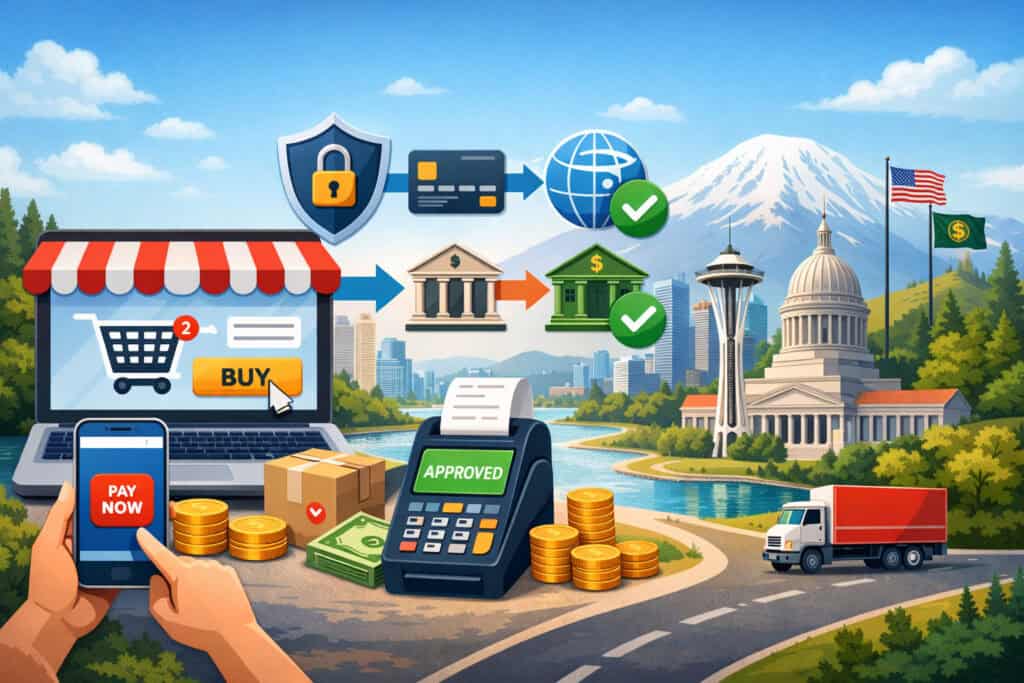
A payment gateway is the technology layer that securely captures payment details, requests authorization, and routes transactions to the right parties—typically a processor and an acquiring bank—so funds can settle into your business account.
For a Washington e-commerce website, the gateway is not just a “checkout plugin.” It’s the system that shapes approval rates, fraud exposure, dispute outcomes, reporting accuracy, and how quickly you can scale to new sales channels.
From an operational view, a payment gateway for Washington e-commerce must handle four jobs consistently well. First, secure data handling: you want tokenization so your site never stores raw card numbers, which reduces PCI scope and lowers security risk.
Second, smart routing and reliability: downtime equals lost revenue, and poor routing equals more declines. Third, risk controls: fraud tooling (device fingerprinting, velocity rules, 3DS where appropriate) protects you without destroying conversion.
Fourth, reconciliation and compliance support: the gateway should give clean, exportable transaction logs, dispute evidence packages, and tax-friendly reporting that your accounting team can actually use.
One Washington-specific consideration is that many merchants here sell across channels—local pickup, regional shipping, subscriptions, and seasonal spikes.
Your gateway choice should match that reality: it should support recurring billing, partial captures, refunds, split shipments, and integrations with your shopping cart, ERP, and customer support stack.
Picking the wrong gateway often shows up later as rising chargebacks, messy books, or being forced into a costly platform migration.
Washington-Specific Requirements That Influence Payment Gateway Selection
Choosing a payment gateway for Washington e-commerce should include a compliance lens that goes beyond generic “PCI compliant” marketing. Washington has tax and privacy realities that can directly affect how you configure checkout, store customer data, and select vendors.
Washington tax registration triggers and marketplace rules that affect checkout strategy
If you sell into Washington (even if you’re not physically located here), you may have to register and collect sales tax once you hit specific thresholds.
Washington’s Department of Revenue explains that remote sellers must register to report certain taxes and collect/submit sales tax if they exceed $100,000 in Washington-sourced gross receipts (current or prior year) or are organized/domiciled in Washington.
This matters for gateway selection because your payment gateway for Washington e-commerce should integrate cleanly with your tax calculation workflow (native integrations or stable APIs) and provide accurate location and order metadata for audit trails.
It also affects marketplace sellers. If you sell on marketplaces and your own site, you need clarity on who collects and remits what, and you need reporting that separates marketplace activity from direct-to-consumer sales.
A strong gateway won’t “do taxes for you” automatically, but it will feed your tax engine and accounting system consistent order and payment records, including refunds and partial captures.
When Washington thresholds are crossed mid-year, clean reporting becomes the difference between a calm registration process and a painful cleanup.
From a practical standpoint: if your Washington e-commerce website is growing, prioritize a gateway with robust exports (transaction ID mappings, settlement batches, fee breakdowns) and well-documented webhooks so your back office can keep up as volume rises. You’re not just buying payments—you’re buying auditability.
Privacy and consumer-data laws: how they change what you should store, share, and log
Washington has enacted health-related consumer privacy requirements that can unexpectedly affect e-commerce businesses—especially those selling wellness, supplements, fitness products, or anything that could imply health status.
The Washington My Health My Data Act is codified in state law (RCW 19.373) and was designed to protect consumer health data collected by entities beyond traditional healthcare organizations.
Even if you’re not a “health company,” product categories, quizzes, symptom-related content, or targeted marketing can create risk if you collect and share sensitive signals.
Why does this matter for your payment gateway for Washington e-commerce? Because gateways and their add-ons (fraud tools, analytics, marketing tags, and “one-click checkout” products) can increase data sharing.
You want a vendor posture that supports data minimization: tokenize payment data, limit what you store, and ensure logs don’t accidentally capture sensitive information.
In addition, Washington privacy proposals continue to evolve—bills and public discussions have kept privacy on the legislative agenda, which is a signal that compliance expectations will likely tighten over time.
For merchants, the best approach is simple: treat your payment gateway as part of your privacy footprint. Ask vendors where data is processed, what is retained, how long it is stored, how disputes and fraud evidence are handled, and whether they support deletion workflows and access controls.
This is how a “payments decision” becomes a durable compliance decision for a Washington e-commerce website.
PCI DSS 4.0 and Security Standards Your Gateway Must Support

Security is where many merchants accidentally buy a future problem. A payment gateway for Washington e-commerce should reduce your exposure to card data, support modern authentication, and make it easier to meet evolving security standards—not harder.
PCI DSS 4.0: what changed and what you should demand from vendors
PCI DSS is maintained by the PCI Security Standards Council (PCI SSC). The standard moved forward with PCI DSS v4.0 (and clarifications via v4.0.1), reflecting stronger expectations around authentication, monitoring, and secure software practices.
Industry guidance and legal analyses emphasize that PCI DSS 4.0 requirements became fully mandatory on a defined schedule—often discussed around spring 2025 compliance milestones for merchants and service providers—meaning “best practice” items are no longer optional in many implementations.
What you should demand:
- Tokenization and hosted fields (or redirect checkout) so your site doesn’t handle raw PAN data.
- Strong access controls for your gateway dashboard: MFA, granular roles, audit logs, and IP restrictions if available.
- Secure API design: signed webhooks, idempotency keys, and scoped API keys.
- Vulnerability management alignment: documented secure development practices and clear responsibility boundaries for patching and incident response.
- Evidence support: if you ever need to show compliance posture, your gateway should provide documentation, attestation support where applicable, and clear configuration guidance.
For a Washington e-commerce website, this isn’t just “IT hygiene.” It impacts conversion too: the safest setup is often the fastest to scale because it reduces the number of systems you must audit.
If you’re choosing between gateways, the one that reduces PCI scope while preserving a smooth checkout is usually the better long-term pick.
Fraud tooling and authentication: balancing conversion with protection
Fraud is not a static problem. A payment gateway for Washington e-commerce should support layered controls: AVS and CVV checks, velocity rules, device fingerprinting, bot detection, and—when appropriate—3DS (3-D Secure) flows.
The key is configurability. If your store sells low-margin products, heavy friction can destroy conversion. If you sell higher-value items, a more aggressive posture can save you from chargebacks and loss.
A strong gateway allows you to build risk rules by: billing/shipping mismatch, high-risk IP ranges, repeated failed attempts, unusually large carts, and “first order” heuristics. It should also support manual review queues with enough data for agents to make decisions fast (issuer response codes, AVS result, verification outcome, and device indicators).
For subscription merchants, you also want built-in account updater support where available and smart retry logic to reduce involuntary churn without triggering fraud filters.
The expert move here is to treat fraud and disputes as one lifecycle. Fraud prevention reduces chargebacks, but dispute readiness wins the chargebacks you still get.
Choose a payment gateway for Washington e-commerce that gives you easy access to compelling evidence: order confirmation, delivery proof, customer communications, refund history, and clear descriptor information.
Core Features to Look For in a Payment Gateway for Washington E-commerce

Features are easy to list and hard to evaluate. The goal is to pick capabilities that improve approvals, protect revenue, and reduce operational friction for a Washington e-commerce website—without paying for complexity you’ll never use.
Checkout and payment method fit: cards, wallets, ACH, BNPL, and local expectations
Start with how customers prefer to pay. Cards remain essential, but wallets and alternative methods can lift conversion, especially on mobile. A payment gateway for Washington e-commerce should support major wallets, stored credentials, and a clean mobile checkout.
If you sell services or B2B items, bank payments can matter too, so evaluate whether the gateway supports ACH flows and how it handles verification and returns.
BNPL can increase average order value, but it comes with fee trade-offs and reconciliation complexity. If you add BNPL, make sure the gateway’s reporting cleanly tags those transactions and settlement timing.
Also look for support for partial captures (common when items ship separately), split shipments, and partial refunds. These are the “unsexy” features that prevent customer service escalations later.
Most importantly, confirm how payment methods interact with your platform. Some gateways offer the smoothest experience only on certain carts or require specific plugins.
For a Washington e-commerce website that may evolve (new theme, headless build, new POS), choose a gateway that works both as a plug-and-play integration today and as an API-first platform tomorrow.
Reporting, reconciliation, and dispute management that your back office will love
Merchants rarely leave a gateway because of the checkout UI alone—they leave because the books are painful. Your payment gateway for Washington e-commerce should provide: settlement batch reports, fee breakdowns (interchange, assessments, markup), payout timing visibility, and transaction-to-order mapping.
If you can’t reconcile payouts to orders quickly, you’ll waste hours each week, and errors will sneak into taxes and inventory planning.
Disputes are another hidden cost. Look for: alerts, guided evidence submission, reason code visibility, and the ability to attach documentation easily. Some gateways make representation a confusing maze; others package evidence with templates that match issuer expectations. This affects win rates.
Also ensure you can manage refunds quickly with proper logging; refund behavior influences dispute outcomes because proactive refunds reduce customer frustration and “friendly fraud.”
From an expert perspective, the best gateway is the one that makes finance and support teams faster. If your Washington e-commerce website is growing, you should treat reconciliation tooling as a top-tier feature—not a footnote.
Understanding Pricing: Interchange, Markup, and Total Cost of Ownership
If you want to choose the right payment gateway for Washington e-commerce, you need to evaluate pricing like an operator, not like a shopper. The cheapest-looking rate is often not the lowest total cost once you factor in approvals, fraud losses, chargebacks, and developer time.
How gateway pricing models really work (and where merchants get surprised)
Most merchants see pricing as a single percentage. In reality, card payments include interchange (paid to issuers), network assessments (paid to card networks), and processor/gateway markup.
Some providers bundle everything into a flat rate; others offer interchange-plus. Flat rate can be fine for simplicity, but it can become expensive as volume grows or if your average ticket is high.
A payment gateway for Washington e-commerce can also introduce “shadow costs” through per-transaction fees, monthly minimums, payout fees, chargeback fees, cross-border fees, and add-on costs for fraud tools, token vaults, or advanced reporting.
You should ask for a complete fee schedule and model it against your real data: AOV, refund rate, card mix (debit/credit), and channel mix (mobile vs desktop, wallet adoption, subscription share).
Another common surprise is how declines affect cost. If your gateway has weaker routing or stricter risk filters, your approvals drop. Lower approvals mean you pay more for customer acquisition per successful sale. So the best “price” is often the gateway that improves acceptance and reduces fraud, even if its markup is slightly higher.
Practical cost-control strategies for Washington e-commerce websites
For many Washington merchants, cost control comes from tightening operations rather than chasing a mythical lowest rate. First, improve approvals: use wallets, optimize descriptors, and ensure billing details match what issuers expect. Second, reduce chargebacks by improving shipping communication, return policies, and customer support response time.
Third, reduce fraud by using layered tools and reviewing high-risk orders. Fourth, choose a gateway with clean reporting so you can quickly spot anomalies.
If your Washington e-commerce website is seasonal (holiday spikes, event-driven demand), negotiate pricing terms that fit your volume curve. Some providers price aggressively only at high volume; others offer stable costs year-round. Also confirm payout timing and reserve policies—cash flow is part of cost.
The expert takeaway: price is not a line item—it’s a system outcome. The right payment gateway for Washington e-commerce lowers total cost by improving approvals and reducing downstream friction.
Matching Gateway Choices to Common Washington E-commerce Business Models
Different models create different payment failure points. The right payment gateway for Washington e-commerce should be chosen based on how you sell, how you fulfill, and what your risk profile looks like.
Subscriptions, memberships, and recurring billing stores
If you run subscriptions (coffee, wellness, membership boxes, software, service retainers), your biggest enemy is involuntary churn: cards expire, issuers decline recurring charges, customers forget updates.
You want a gateway with strong recurring tooling: stored credential compliance, smart retries, account updater support where available, and clean dunning integrations.
Disputes can also look different. Subscription chargebacks often come from “I forgot I signed up” or unclear descriptors. A payment gateway for Washington e-commerce should let you customize descriptors and maintain a clear billing history that you can export when disputes happen.
You also want proration support, easy upgrades/downgrades, and immediate cancellation/refund workflows so customer support can resolve issues before they escalate.
A real-world example: a Seattle-area subscription brand offering monthly specialty products may see spikes in address changes and failed payments after holidays.
A gateway that automatically prompts wallet usage or updates expired credentials can preserve revenue without adding friction. For Washington e-commerce websites, subscription-friendly gateway design is a direct revenue lever.
Marketplaces, multi-vendor stores, and complex payouts
If your Washington e-commerce website runs a marketplace model (multiple sellers, commission splits), gateway selection becomes more complex.
You need capabilities like split payments, sub-merchant onboarding, seller identity verification, and compliant payout handling. Even if your business is small today, marketplace growth makes retrofitting painful.
In marketplace setups, fraud and disputes can become messy: who owns the chargeback, who provides evidence, who gets debited?
The right payment gateway for Washington e-commerce should provide clear ledgering so each seller’s balance and payout is traceable. You also want strong API and webhook reliability because marketplaces depend on automation (order routing, payouts, refund distribution).
From an operator standpoint, marketplace payments are where “nice dashboards” are meaningless and platform-grade tooling matters. If you plan to scale beyond a simple storefront, pick a gateway that supports the financial architecture you’ll need later—otherwise you’ll face a rebuild when seller count grows.
Implementation and Integration: How to Launch Without Breaking Conversion
Even the best payment gateway for Washington e-commerce can fail if implementation is sloppy. Your rollout should protect conversion, preserve analytics, and ensure accounting integrity from day one.
Integration paths: hosted checkout, embedded fields, or API-first builds
You typically choose between: redirect/hosted checkout, embedded hosted fields (where sensitive data goes directly to the gateway), or full API custom checkout (highest control, higher compliance burden).
For most Washington e-commerce websites, hosted fields are a strong middle ground: you get design control and lower PCI scope because raw card data is handled by the gateway.
If you run a headless storefront or custom build, API reliability and documentation quality become critical. Look for: stable SDKs, webhook signatures, idempotency, versioned APIs, and sandbox tools that mimic production behaviors.
A payment gateway for Washington e-commerce should also support payment intent flows (authorize first, capture later) so you can handle out-of-stock scenarios, split shipments, or manual review.
Migration planning matters too. Ask how token portability works. If you ever need to switch processors, can tokens move, or will you be forced to re-collect cards? This single detail can determine whether a future migration is a normal project or a business-threatening event.
Testing, monitoring, and post-launch optimization
Your launch checklist should include: decline reason analysis, fraud rule tuning, chargeback workflow testing, refund testing, and settlement reconciliation.
Too many stores launch and only check “did a payment go through?” That’s not enough. You should test partial captures, partial refunds, voids, subscription retries, and dispute evidence exports.
Monitoring is the next layer. A payment gateway for Washington e-commerce should provide webhooks and alerts for spikes in declines, unusual refund patterns, or fraud-rule hit rates. If your approvals suddenly drop, you need to know within hours, not weeks.
Over time, optimize checkout by encouraging wallet usage on mobile, adjusting 3DS triggers to protect high-risk orders without harming low-risk conversions, and improving descriptors to reduce “merchant not recognized” disputes.
The expert mindset: payments is a living system. Pick a gateway you can tune, not one you can only tolerate.
Future Predictions: Where Payment Gateways Are Headed for Washington E-commerce
Future-proofing doesn’t mean buying the most complex platform. It means choosing a payment gateway for Washington e-commerce that aligns with where commerce, security, and regulation are trending.
Security and compliance will keep tightening (and vendors will be judged by defaults)
PCI DSS 4.0’s shift toward stronger baseline controls is part of a broader pattern: regulators and standards bodies are expecting stronger defaults, better monitoring, and more accountability.
PCI SSC’s continued updates (including clarifications like v4.0.1) reinforce that merchants should expect standards to evolve, not freeze. Gateways that make compliance “your problem” will feel heavier over time. Gateways that reduce your PCI scope and provide secure-by-default tooling will win.
At the state level, privacy activity remains active, with Washington bills and advocacy efforts continuing to push stronger consumer protections. This suggests that data minimization, retention controls, and vendor governance will become more important selection criteria, not less.
If your Washington e-commerce website touches sensitive categories (wellness, health-adjacent products), you should assume scrutiny will rise.
Payments will get more “real-time,” more tokenized, and more diversified
Expect continued growth in tokenization, network token adoption, and wallet-first experiences. Merchants will push for fewer card re-entries and lower fraud, which tokens help enable. Alternative rails will also remain relevant: bank payments, instant-like experiences, and smarter payout tools will keep improving.
For a Washington e-commerce website, this means your gateway should be adaptable: add new payment methods without a rebuild, support modern checkout UX, and provide strong APIs.
Another likely trend is more automation in disputes and fraud detection. But automation only helps if you can control it. Choose a payment gateway for Washington e-commerce that lets you see why decisions were made and tune the rules. Black-box declines can become a growth ceiling.
The forward-looking advice is straightforward: select a gateway that is modern in security posture and flexible in payment method expansion, while keeping reporting clean. That combination tends to age well.
FAQs
Q.1: What is the best payment gateway for Washington e-commerce if I’m just starting out?
Answer: For a new Washington e-commerce website, “best” usually means: easy integration with your cart, strong fraud defaults, fast onboarding, and reporting that won’t confuse you at tax time.
Start by prioritizing stability and simplicity: a gateway that offers hosted fields or a secure hosted checkout reduces your PCI exposure, and good dashboard tools help you understand approvals, refunds, and chargebacks early.
Also consider how quickly you might expand. Many merchants launch on a simple setup and later add subscriptions, BNPL, or a second sales channel. Your payment gateway for Washington e-commerce should make those upgrades possible without forcing a full rebuild.
Even if you don’t need advanced APIs on day one, it’s wise to pick a provider with mature documentation so you can evolve. Finally, make sure the provider can support clean exports and integrations with accounting tools—because the first time you reconcile payouts, you’ll feel the difference between “beginner-friendly” and “beginner-trap.”
Q.2: Do I need to worry about PCI DSS if my payment gateway says it’s PCI compliant?
Answer: Yes—because PCI compliance is shared responsibility. A payment gateway for Washington e-commerce can reduce your PCI scope dramatically, but your business still has obligations depending on how payment data flows through your website.
If you use hosted checkout or hosted fields and avoid storing card data, your scope is typically smaller. If you build a fully custom checkout or store sensitive data, your obligations increase.
PCI DSS 4.0 is particularly important because it reflects stronger security expectations and a clear move away from optional “best practices” on a defined timetable.
The practical takeaway is to design your checkout so sensitive data never touches your servers, enforce MFA on dashboards, limit user access, and ensure your integrations use signed webhooks and scoped API keys. “Gateway is compliant” is helpful, but it’s not the same as “your system is safe by design.”
Q.3: How do Washington taxes affect my payment gateway decision?
Answer: Washington’s Department of Revenue notes that remote sellers may need to register and collect sales tax once they exceed thresholds like $100,000 in Washington-sourced gross receipts (current or prior year), among other triggers.
Your payment gateway for Washington e-commerce should support your tax workflow by passing consistent order data to your tax engine and accounting system, including refunds and partial captures.
It also matters for audit readiness. If you ever need to reconcile collected taxes against sales, you’ll rely on transaction records, settlement batches, and clean exports.
Gateways that provide detailed metadata (shipping address, order ID mapping, product/category tags where supported) make it easier to defend numbers. So taxes don’t change which gateway is “allowed”—they change which gateway is operationally safe as you scale.
Q.4: What if my store sells health-adjacent or wellness products in Washington?
Answer: If your Washington e-commerce website collects or uses data that could be considered consumer health data, you should be aware of Washington’s My Health My Data Act (RCW 19.373), which aims to protect consumer health data collected beyond traditional healthcare contexts.
Even if you’re not a healthcare provider, product types, quizzes, or tracking behaviors can create privacy risk.
In that scenario, choosing a payment gateway for Washington e-commerce should include a privacy review: minimize data collection, ensure your gateway and fraud tools don’t over-collect, and confirm vendor retention and sharing practices.
Tokenization and strict access controls become even more important. This is also where clear internal policies matter—what you log, what you store, and how you respond to consumer requests. A gateway that supports data minimization and strong security defaults is a safer long-term pick.
Q.5: How can I reduce chargebacks with the right payment gateway for Washington e-commerce?
Answer: Chargebacks are reduced through a mix of prevention, communication, and evidence. Your payment gateway for Washington e-commerce should support: configurable fraud rules, optional 3DS triggers for higher-risk transactions, strong logging, and a dispute portal that makes evidence submission easy.
You also want clean descriptors so customers recognize the charge on their statement—many “friendly fraud” disputes begin with confusion.
On the business side, reduce disputes by improving shipping communication, making return/refund policies easy to find, and responding quickly to support tickets.
Then use your gateway’s reporting to identify patterns: which products, which traffic sources, which shipping methods, and which customer segments generate disputes. The right gateway doesn’t magically eliminate chargebacks, but it gives you the control and data to win more disputes and prevent repeat issues.
Conclusion
Choosing the right payment gateway for Washington e-commerce is about aligning three things: (1) compliance and security posture, (2) operational reality, and (3) growth direction. On compliance, prioritize tokenization, reduced PCI scope, strong dashboard access controls, and vendors that clearly support PCI DSS 4.0 expectations as security standards tighten.
On operations, demand clean reporting, dependable webhooks, easy refunds, and dispute tooling that your finance and support teams can actually use. On growth, pick a gateway that can add payment methods, handle subscriptions or complex payouts if needed, and integrate with your platform without fragile plugins.
For Washington e-commerce websites specifically, keep tax and privacy realities in your selection process. Washington’s registration and sales tax thresholds for remote sellers make reporting quality and metadata consistency more important than many merchants expect.
Privacy risk is also part of the payments ecosystem—especially for health-adjacent categories—so vendor governance and data minimization matter.