By washingtonmerchantservices February 12, 2026
Washington retailers are operating in a payment environment that’s moving faster than almost every other part of commerce.
Customer expectations now include tap-to-pay everywhere, mobile wallets that “just work,” frictionless returns, same-day refunds, and consistent pricing and loyalty whether the shopper is in-store in Bellevue, ordering online from Yakima, or picking up curbside in Tacoma.
From an operator’s perspective, “modern payment solutions” are no longer a single card terminal choice. They’re a connected stack: POS + payment gateway + fraud controls + customer data permissions + receipts + inventory + accounting + tax + chargeback workflows.
When these pieces don’t talk to each other, the customer feels it as lag, confusion, or distrust (“Why did you ask for my card again?”). When they’re integrated well, the customer feels it as speed and confidence—often without thinking about payments at all.
This guide explains how Washington retailers can design a payment experience that is fast, secure, compliant, and future-ready, using industry standards (PCI DSS, EMV, tokenization) and real-world examples.
It also highlights local considerations such as gift certificate rules and cash-acceptance requirements in certain areas, and it includes practical future predictions based on current network and regulatory direction.
Why Modern Payment Solutions Matter for Washington Retailers
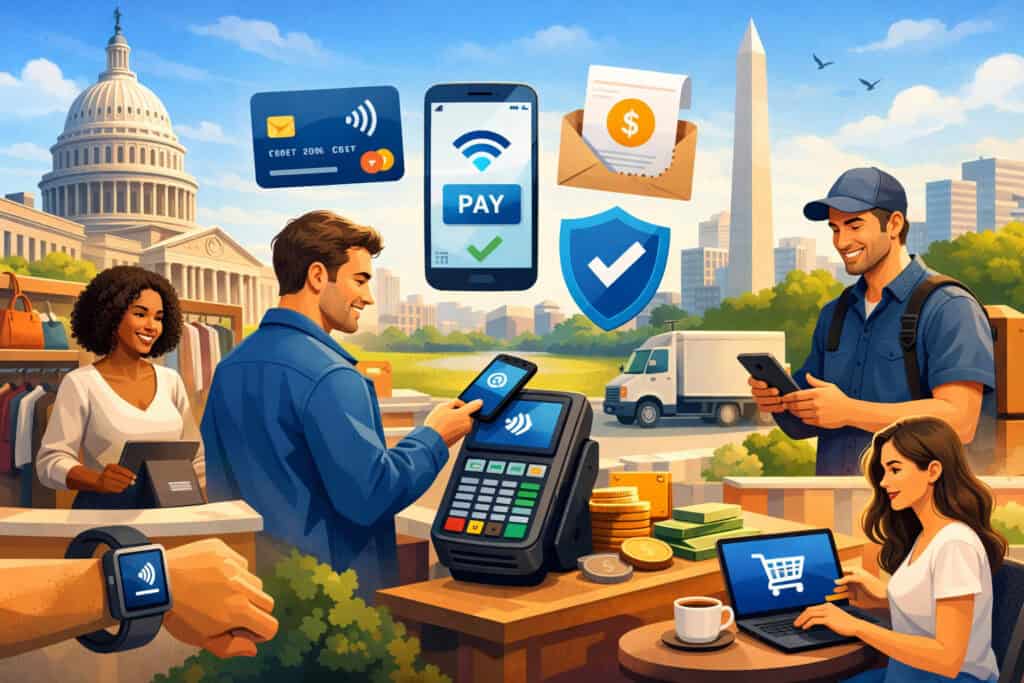
For many Washington retailers, the “payment moment” is where the sale is either won or lost. Shoppers may love your product selection, but they remember the last 90 seconds: the line, the tap that didn’t work, the awkward request for a different card, or the uncertainty about whether a refund will take two hours or two weeks.
Modern payment solutions reduce those pain points by combining reliable acceptance with smart routing and security that happens in the background.
Modern payment solutions also directly influence margins. A well-configured checkout can reduce abandoned carts, lower chargeback exposure, and minimize manual reconciliation.
For example, a multi-location specialty retailer in the Seattle metro area can unify inventory and payments so returns are possible at any store, while automatically matching refunds to original payment tokens rather than requiring the cashier to re-key card details. That’s not just a convenience feature—it reduces fraud and staff error, and it improves customer trust.
There’s also a competitive reality: national chains have trained customers to expect contactless, digital receipts, split payments, stored payment credentials, and instant refunds.
Local retailers can absolutely match that experience, but it requires choosing payment tools that support EMV contactless, mobile wallets, tokenization, and omnichannel reporting—and implementing them with a customer-first flow rather than a “terminal-first” flow.
Finally, Washington retailers need to keep one eye on compliance, especially around security and data handling. PCI DSS is evolving toward more continuous security practices, and newer privacy rules can affect how you store and use customer data.
PCI SSC’s updates around PCI DSS v4.x and transition timelines are key drivers for how retailers should modernize security programs now.
The New Customer Experience Baseline: Speed, Choice, and Trust
The most successful retailers design checkout around three customer expectations: speed, choice, and trust. Speed isn’t just about processing time—it’s about eliminating extra steps.
Choice means the customer can pay how they want without judgment: tap, insert, wallet, QR, gift card, store credit, or split tenders. Trust is the invisible layer: clear totals, predictable refunds, and a feeling that their payment data is safe.
In Washington retail corridors—high foot traffic urban neighborhoods, suburban shopping centers, and destination tourism zones—speed matters because labor is expensive and lines create immediate drop-off.
If customers see a queue, they self-select out. Modern payment solutions help by enabling tap-to-pay, device-based acceptance, and digital receipts that don’t require waiting for printing. The goal is fewer “conversation bottlenecks” at checkout: no repeated prompts, no re-scans, no awkward “try it again.”
Choice matters because one household might pay with a mobile wallet, another with a debit card, another with a buy-now-pay-later option for bigger baskets, and another with a gift certificate.
If your system treats any of those as “edge cases,” staff will improvise, and customers will feel it. Modern payment stacks handle these tenders natively and report them cleanly.
Trust is where security and transparency come together. Customers increasingly recognize “secure patterns” like wallet tokenization and EMV prompts. When a retailer still swipes everything, or asks to text a photo of a card for an order, trust drops.
Using modern payment methods aligned with EMV and tokenization standards improves customer confidence while reducing fraud exposure. EMVCo’s payment tokenization framework is central to this direction.
In-Store Modernization: EMV, Contactless, and Tap-to-Pay Foundations
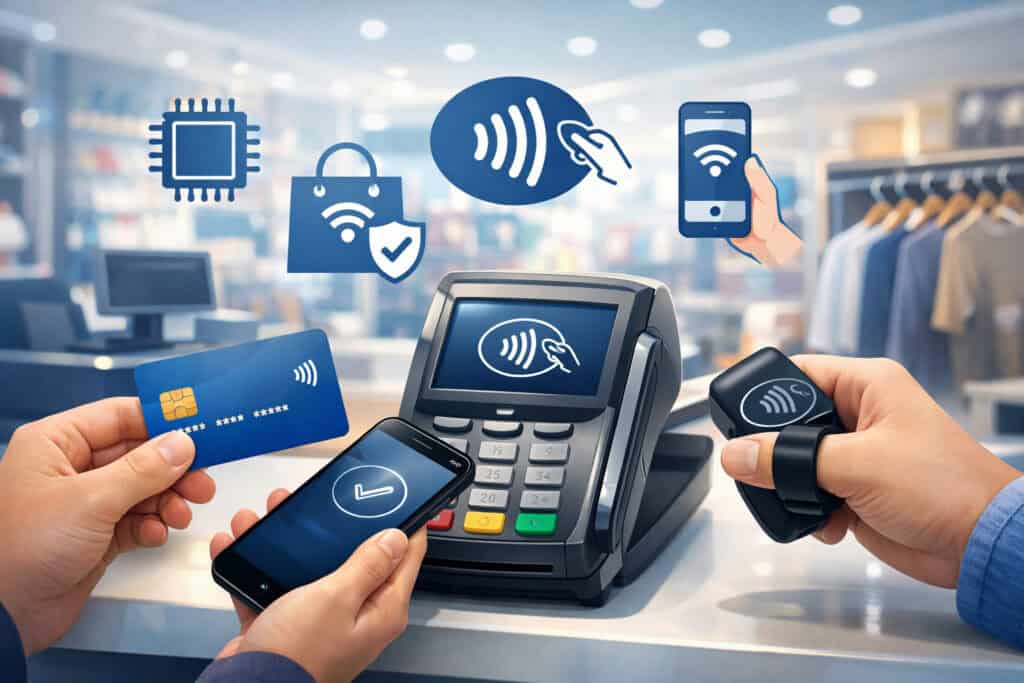
If you upgrade only one thing, upgrade in-store acceptance to a modern EMV + contactless baseline. The reason is simple: it improves the customer experience immediately, and it reduces liability and fraud patterns associated with older acceptance methods.
A modern in-store setup includes:
- EMV chip acceptance (insert)
- EMV contactless acceptance (tap)
- Support for mobile wallets (e.g., device wallets that use tokenized credentials)
- Optional Tap to Phone (accepting contactless payments on a mobile device)
- Fast, stable connectivity with offline/queued transaction logic (where supported)
From a customer standpoint, contactless is now “the normal way.” The best retailers design the checkout flow so customers see an obvious tap symbol and don’t have to ask, “Do you take tap?”
Staff should be trained to present the terminal early and at the right angle, reducing awkward handoffs. It sounds small, but it directly affects perceived speed.
From a risk standpoint, EMV contactless and tokenized wallet payments reduce exposure to certain fraud types because the credential used in the transaction is not the raw card number.
EMVCo explains how payment tokenization replaces valuable card data with tokens and supports secure mobile and ecommerce payments while staying compatible with existing payment infrastructure.
Real-world example: A boutique in Capitol Hill can cut average transaction time by enabling tap-to-pay and digital receipts, while also reducing “card present but counterfeit” scenarios.
A hardware retailer in Spokane can keep lines moving during weekend rushes by using handheld devices with contactless acceptance at the aisle, converting “I’ll think about it” into “I’ll take it.”
Omnichannel Payments: One Customer, One Cart, One Consistent Experience

Modern retail is omnichannel by default. Even customers who buy in-store often browse online first, check inventory, compare prices, and read reviews. Your payment system should support a single customer experience across in-store, online, and pickup/delivery.
Omnichannel payments aren’t just “having a website.” They require:
- A unified product catalog and inventory view
- Consistent pricing and promotions
- A shared customer profile (with consent)
- A way to handle returns and exchanges across channels
- Unified reporting for sales, refunds, and chargebacks
For Washington retailers, omnichannel also intersects with tax, marketplace rules, and operational complexity. If you sell through marketplaces in addition to your own channels, understand who is responsible for collecting and remitting certain taxes under “marketplace facilitator” rules and when remote sellers must register based on thresholds.
Washington’s Department of Revenue provides detailed guidance for marketplace facilitators and marketplace sellers, including threshold and registration context.
Customer experience example: A customer orders online for curbside pickup in Redmond. They expect the same payment options, the same loyalty points, and the same refund timeline as if they purchased in-store.
If your staff has to “re-ring” orders in a separate terminal, errors happen. A unified system lets you authorize online, capture at pickup if needed, and process refunds to the original token automatically.
Operationally, omnichannel reduces “blind spots” that cause customer frustration: missing receipts, delayed refunds, and unclear return eligibility. When payment data, order data, and inventory data align, you can confidently offer the policies customers expect—without your staff guessing.
Digital Wallets and Tokenization: Safer Convenience Customers Actually Use
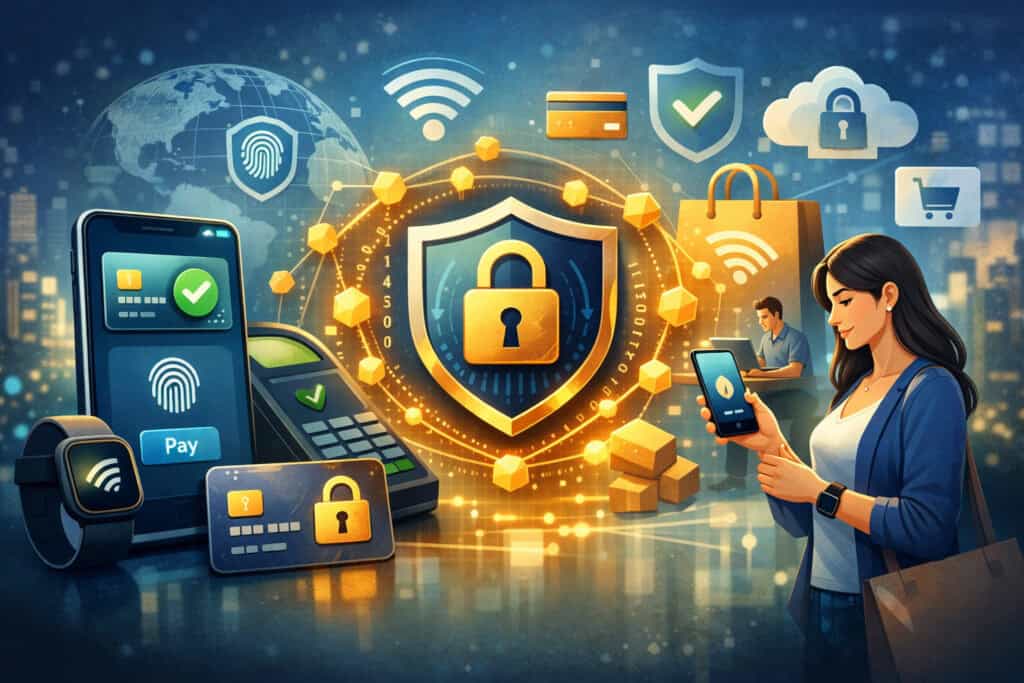
Digital wallets are no longer a “nice extra.” For many customers, they are the default way to pay—especially for quick trips and repeat purchases. Supporting wallets improves conversion, speeds checkout, and can reduce certain fraud risks because wallet transactions commonly use tokenized credentials rather than raw card data.
Tokenization is the technical core that makes wallets safer. Instead of passing the original card number through every step, tokenization replaces it with a token that is usable for the intended context.
EMVCo’s payment tokenization approach is designed to increase security for mobile and ecommerce transactions while preserving compatibility with existing payment rails.
For Washington retailers, the customer experience benefit is immediate:
- Faster checkout (tap and go)
- Less fumbling with cards
- More consistent approvals in many scenarios
- Higher trust perception (“this feels modern and secure”)
Real-world example: A coffee and bakery shop in Bellingham can handle the morning rush more smoothly when most customers tap with a phone or watch. Staff can focus on service and upsell rather than waiting for chip reads.
A mid-ticket apparel retailer can also use wallet-ready online checkout to reduce cart abandonment, especially on mobile, because customers can complete the purchase without typing long card details.
To maximize the benefit, retailers should ensure wallet acceptance is visible at the door, at checkout, and online.
Also, if you store customer credentials for subscriptions or repeat delivery, prioritize tokenized storage and strong authentication patterns rather than storing sensitive card data directly. This aligns with modern security expectations and reduces compliance burden.
Flexible Payments: BNPL, Split Tender, and Smart Affordability Options
Customers don’t just want to pay quickly—they want to pay in a way that matches their budget and preferences. Flexible payment solutions can increase average order value and conversion, especially for higher-ticket categories like furniture, specialty apparel, electronics accessories, fitness equipment, or seasonal outdoor goods.
Modern flexibility includes:
- Split tender (gift card + card, cash + card, multiple cards)
- Buy Now, Pay Later (BNPL) options at checkout
- Store credit and seamless exchanges
- Digital invoicing for special orders or B2B-like retail transactions
The customer experience win is giving shoppers control without making it awkward. If a customer wants to split a purchase across two methods, the POS should support it with minimal steps. Staff training matters here: the best experience is calm and confident, not “we can try, but it might not work.”
From a risk perspective, retailers should treat flexible payments as a policy decision, not just a feature toggle. BNPL shifts chargeback patterns and customer support demands in different ways depending on the provider.
Your system should clearly reconcile tender types, handle refunds correctly (especially partial refunds), and communicate expectations to customers in receipts and post-purchase messaging.
Real-world example: A home goods retailer in Tacoma introduces BNPL for baskets over a certain threshold and sees conversion lift on higher-priced items.
The key is making returns easy: refunding the original tender correctly and quickly, with clear messaging that the customer’s BNPL schedule may update based on provider rules.
Gift Cards, Store Credit, and Loyalty: Payments That Bring Customers Back
Gift cards and loyalty programs are not “marketing extras.” They are payment-adjacent tools that drive repeat business, increase retention, and build predictable revenue. For Washington retailers, it’s also important to align gift card policies with state consumer protection rules.
Washington law includes protections around gift certificates, including restrictions on practices that deprive consumers of value such as expiration dates and certain fees, with specific exceptions in defined cases. Retailers should understand the rules and configure gift card programs accordingly.
A modern gift card and loyalty setup includes:
- Physical and digital gift cards
- Balance checks and reloads
- Easy redemption online and in-store
- Automated fraud controls on high-risk gift card patterns
- Loyalty linked to customer identity (email/phone) with consent
- Rewards that apply across channels
Customer experience example: A retailer in Spokane sells digital gift cards that can be added to mobile wallets and redeemed in-store via barcode or token-based lookup. The customer doesn’t need to print anything, and the cashier doesn’t need manual codes. That lowers friction and reduces embarrassment at checkout.
Loyalty works best when it feels effortless. If a customer has to repeat their phone number three times, or loyalty discounts don’t apply online, they’ll stop engaging.
Tie loyalty to the payment experience carefully: some systems can recognize a customer via tokenized payment or receipt lookup, but always prioritize transparent consent and privacy-safe practices.
Faster Money Movement: Same Day ACH, Instant Payments, and Better Refund Experiences
Refund speed is part of customer experience now. Customers often judge retailers by how quickly money returns to their account, not just how politely staff handled the return. Modern payment solutions improve refund experience through better routing, faster rails where available, and clearer customer communication.
Two major categories matter for retailers:
- Bank-to-bank rails (ACH and instant payment networks)
- Card refund processes (which vary by issuer and method)
Same Day ACH is a meaningful tool for many business payments and certain payout use cases. Nacha provides guidance on Same Day ACH expansion and processing concepts, and industry discussions continue around windows and operational impacts.
Instant payments are also expanding. The Federal Reserve’s FedNow Service is an instant payment platform designed to support 24x7x365 payments, with features such as request-for-payment capability and fraud tools, with ongoing enhancements over time.
Retailer impact (practical): While many consumer refunds still land through card rails, retailers increasingly use instant or ACH-based rails for supplier payments, gig/contractor payouts, marketplace seller settlements, and customer reimbursements in certain contexts.
The future-facing opportunity is using request-for-payment and instant settlement options to reduce “where is my money?” support tickets, and to improve customer confidence after returns or order changes.
Security and Fraud: Designing Checkout That Feels Easy but Is Hard to Attack
Fraud prevention is best when customers barely notice it. Washington retailers need fraud controls that reduce risk without adding friction to legitimate buyers. Modern payment solutions help by using tokenization, device intelligence, and layered authentication for higher-risk moments.
Key components include:
- PCI DSS-aligned security controls
- Tokenization for stored credentials and recurring transactions
- EMV contactless and chip support in-store
- 3-D Secure strategies for ecommerce (risk-based authentication)
- Real-time monitoring for refund abuse and gift card scams
- Clear internal workflows for disputes and chargebacks
PCI DSS remains the core security standard for cardholder data environments, and PCI DSS v4.x is driving broader expectations around continuous security practices and updated control requirements.
Official PCI SSC communications around v4.x updates and transition timelines are important reference points for merchants and service providers.
Real-world example: A multi-location retailer in the Puget Sound region sees a spike in “item not received” claims after expanding delivery.
They add address verification, stronger delivery confirmation, and step-up authentication for high-risk orders—while keeping wallet checkout fast for low-risk repeat customers. The experience remains smooth for most buyers, but fraud rates fall because controls are targeted.
Also remember internal fraud: employee refund abuse, no-receipt returns, and gift card manipulation. Modern systems reduce this by requiring role-based permissions, audit logs, and manager approvals on specific actions. Security is not just “IT.” It’s also operational design.
Privacy, Receipts, and Data Governance: Modern Payments in a Privacy-Conscious Market
Payments touch customer data—emails for receipts, phone numbers for loyalty, addresses for delivery, and sometimes sensitive contextual data depending on what you sell. Retailers should design data flows so they only collect what they need, store it safely, and honor customer rights.
Washington has emphasized privacy protections for personal health data through the My Health My Data Act, which can matter for retailers whose operations may involve consumer health data (depending on products, services, or tracking practices). The Washington Attorney General’s office provides overview context on this law and its purpose.
Practical implication: If you run a retail model that collects data that could be considered health-related (for example, certain wellness or health-adjacent products with personalized recommendations, or tracking tied to health decisions), you should review how data is collected, shared, and used—especially for advertising and analytics.
Even if you’re not a “health business,” marketing pixels and third-party tracking can create unexpected risk if they collect or infer sensitive data.
From a customer experience angle, privacy done well builds trust:
- Offer digital receipts without forcing marketing opt-in
- Make loyalty terms clear and easy to understand
- Avoid “dark patterns” and over-collection of data
- Keep preferences consistent across channels
The operational win is also real: clean data governance reduces breach risk, reduces disputes, and makes your business easier to scale—because you know where customer data lives and why.
Cash Acceptance, Accessibility, and Local Expectations
Modern payments should not unintentionally exclude customers. Some communities still rely on cash, and certain local rules may require cash acceptance in specific jurisdictions. Retailers should understand local requirements and design policies that balance inclusivity, safety, and operational efficiency.
In unincorporated King County, an ordinance has been passed to require certain retail businesses to accept cash, with public communications indicating implementation timing and intent focused on access for cash-reliant residents.
Even where cashless is allowed, consider the customer experience impact: refusing cash can create friction and negative brand perception, especially for essential goods. A practical approach is “cash-friendly but cash-minimized”: accept cash, but encourage contactless through faster lanes, clear signage, and optional digital receipts—without penalizing cash users.
Accessibility also includes:
- Clear prompts on terminals
- Adequate time for EMV reads
- Receipts in accessible formats (email/SMS choice)
- Staff training to assist without judgment
Washington retailers can modernize payments while still serving the broadest customer base. Inclusivity is not just good ethics—it reduces lost sales and reputational risk.
Implementation Playbook: How Washington Retailers Modernize Without Disruption
The biggest modernization mistakes happen when retailers treat payments as a hardware swap rather than a business process change. A modern payment solution rollout should be staged and measured.
A practical playbook:
- Map the customer journeys (in-store, online, pickup, returns)
- Define “must-have” payment methods (tap, wallets, split tender, gift cards)
- Confirm integrations: POS, inventory, accounting, ecommerce, loyalty
- Design security: tokenization, access controls, PCI scope reduction
- Train staff with scripts and failure-handling (“If tap fails, do X”)
- Pilot in one location or one lane, then expand
- Monitor metrics: checkout time, approval rates, refunds time, chargebacks, customer satisfaction
Real-world example: A retailer in Vancouver rolls out contactless lanes first, trains staff on positioning and prompts, then introduces digital receipts and loyalty sign-up in a second phase. They avoid overwhelming staff and can measure each change’s impact.
Also build a “payments exception plan”:
- What happens when the internet drops?
- What’s the process for offline modes or deferred captures (where supported)?
- How do you handle returns without an original receipt?
- Who approves manual adjustments?
Modern payment solutions shine when exceptions are handled gracefully. Customers forgive the occasional system hiccup; they don’t forgive confusion or distrust.
Future Predictions: Where Modern Payment Solutions Are Headed in Washington Retail
The future of retail payments is a combination of faster rails, more tokenization, more device-based acceptance, and more regulation around data handling. The “winning” payment experiences will feel simpler to customers while becoming more sophisticated behind the scenes.
Here’s what’s likely next:
- Tap to Phone expands for line-busting and pop-up retail, reducing hardware dependence.
- Instant payment adoption grows through platforms like FedNow as banks and providers build consumer-facing products on top of instant settlement and request-for-payment concepts.
- Tokenization everywhere: not just wallets, but stored credentials, subscriptions, and omnichannel identity linking.
- Fraud becomes more behavioral: AI-driven risk scoring, device signals, and real-time decisioning, with fewer blunt tools like blanket declines.
- Privacy enforcement tightens: retailers will need stronger governance around analytics, ad tech, and any sensitive-data-adjacent collection.
- Receipts evolve into post-purchase experiences: reorder, returns, warranty, and loyalty embedded into digital proof-of-purchase.
For Washington retailers, the opportunity is to compete on experience, not just price. Payments are a lever: when checkout is fast, flexible, and trustworthy, customers come back—and they recommend you.
FAQs
Q.1: What are the must-have modern payment methods for Washington retailers today?
Answer: At minimum, Washington retailers should support EMV chip, contactless tap-to-pay, and mobile wallets. Add digital receipts, gift cards, and split tender support to meet common customer needs. If you sell online, prioritize fast mobile checkout, tokenized saved payments, and strong fraud controls.
Q.2: How do modern payment solutions reduce fraud without hurting the customer experience?
Answer: They reduce fraud by using tokenization, EMV standards, and risk-based controls—so legitimate customers get a smooth path while suspicious transactions get extra verification. EMV tokenization standards are designed to improve security while staying convenient and compatible across channels.
Q.3: Do Washington retailers need to worry about gift card expiration and fees?
Answer: Yes. Washington rules include consumer protections designed to prevent retailers from reducing gift certificate value through expiration dates and certain fees, with limited exceptions. Retailers should align gift card configurations and terms accordingly.
Q.4: What’s the role of FedNow and instant payments for retailers?
Answer: Instant payments can improve certain payout and settlement workflows and may support future consumer-facing experiences like faster reimbursements or request-for-payment. The Federal Reserve describes FedNow as an instant payments service with optional features and continuing enhancements over time.
Q.5: Are cashless stores allowed everywhere in Washington?
Answer: Policies can vary by jurisdiction, and some areas have adopted requirements focused on ensuring cash access for residents. For example, unincorporated King County has passed an ordinance requiring certain retail businesses to accept cash, reflecting public policy concerns about excluding cash-reliant customers.
Q.6: What’s the fastest way to modernize payments without disrupting operations?
Answer: Start with a pilot: upgrade one lane or one location to modern contactless acceptance, train staff thoroughly, then expand. Phase in digital receipts, loyalty, and omnichannel returns after the in-store flow is stable. Measure results like checkout time, approval rates, refund handling, and chargebacks.
Conclusion
Modern payment solutions for Washington retailers aren’t about chasing trends—they’re about meeting the new baseline of customer expectations: speed, choice, and trust.
Retailers who modernize acceptance with contactless and wallet-ready checkout, unify omnichannel payment data, and implement security and privacy practices aligned with evolving standards create a customer experience that feels effortless.
At the same time, strong execution requires local awareness: gift certificate rules, cash-access expectations in certain jurisdictions, and careful data handling—especially as privacy regulation around sensitive data gets more attention.
The retailers that will outperform over the next few years will treat payments as a strategic customer experience layer: integrated, secure, and designed around real journeys—browsing, buying, picking up, returning, and reordering.
If you build that foundation now, you’ll not only improve conversion and loyalty today—you’ll also be ready for what’s next: broader tokenization, faster settlement options, smarter fraud controls, and checkout experiences that keep getting simpler for the customer while becoming more powerful behind the scenes.