
By washingtonmerchantservices February 12, 2026
Running a local business today means you’re in the payments business, too. Whether you sell coffee in Seattle, operate a home-services company in Spokane, manage a boutique in Tacoma, or run an online brand shipping statewide, your payment experience shapes customer trust, cash flow, and margins.
The right payment processing solutions do more than “take cards.” They help you get paid faster, reduce fraud, simplify taxes and reconciliation, support omnichannel sales, and keep you aligned with card-network rules and state requirements.
In Washington, small businesses often face a unique mix of customer expectations (tap-to-pay, mobile wallets, subscription billing), seasonal volume swings (tourism, events, farmers markets), and cost pressures (interchange, network fees, chargebacks).
That’s why choosing payment processing solutions should be treated like selecting a core operating system: it must be reliable, scalable, and built for your business model—not just the lowest advertised rate.
This guide breaks down payment processing solutions for Washington small businesses with an expert, practical lens. You’ll learn how modern processing works, what to look for in a provider, how to avoid common pricing traps, how to manage chargebacks and fraud, and how to stay compliant with key standards and state rules.
You’ll also see real-world examples and future-ready strategies so your payments stack can evolve with customer behavior and the next wave of payment technology.
Understanding the Washington payments landscape for small businesses

Washington’s small-business economy is diverse: retail storefronts, professional services, trades, health and wellness, hospitality, subscription services, and fast-growing ecommerce brands. That diversity matters because payment processing solutions are never “one size fits all.”
A counter-service restaurant needs lightning-fast checkout and tip prompts. A contractor needs invoicing, deposits, and mobile payments. An ecommerce seller needs secure checkout, strong fraud tools, and smooth refunds. A multi-location retailer needs consolidated reporting and inventory sync.
Customer payment preferences also vary by area. Metro customers may strongly prefer tap-to-pay and mobile wallets, while some rural or service-based customers still like invoices, ACH, or card-on-file.
If your system can’t accept the way customers want to pay, you’ll lose sales—especially when the “competition” is often the business next door with a simpler checkout.
Taxes and reporting add another layer. Businesses selling through marketplaces should understand that marketplace facilitators can have specific responsibilities for collecting and remitting retail sales tax under state rules, and guidance from the Washington Department of Revenue can affect how sellers and facilitators handle tax collection and liability.
Finally, compliance and security are not optional. The minute you accept card payments, you enter an ecosystem shaped by card-network rules and security standards.
Strong payment processing solutions help you reduce risk by supporting tokenization, secure customer authentication flows, and PCI-aligned handling of card data—so you’re not improvising security on your own.
Core components of payment processing solutions

When small businesses compare processors, they often focus on rates and hardware. But real performance comes from the full stack: the payment gateway, processor/acquirer relationship, fraud tools, POS software, reporting, and support. Robust payment processing solutions are built from several components working together.
- Payment gateway: This is the technology layer that securely transmits transaction data from your checkout (online, mobile, or POS) to the processor. For ecommerce, the gateway is the “bridge” between your website’s checkout and the banking/card network rails. For in-person, your POS app and terminal firmware often play a similar role.
- Merchant account or payment facilitator setup: Some providers set you up with a dedicated merchant account, while others use aggregated or “facilitated” models. Dedicated setups can offer stability and pricing transparency, while facilitated models can be faster to onboard and easier for very small sellers. The best payment processing solutions match the account model to your risk profile, volume, and industry.
- Card-present and card-not-present capabilities: In-person (card-present) transactions often have different pricing and fraud risks than online (card-not-present). If you sell in both worlds, you need payment processing solutions that unify customer records, refunds, and reporting across channels.
- Settlement and funding: How quickly you receive funds—and how holds are handled—can materially impact cash flow. Great payment processing solutions provide clear settlement timelines, weekend/holiday expectations, and tools to track deposits and fees.
- Operational tools: Invoices, subscriptions, tips, split tender, partial approvals, digital receipts, and role-based staff permissions are not “extras.” These are often the features that make your payments system feel effortless and professional, which improves conversion and reduces errors.
Choosing between in-person, online, mobile, and omnichannel setups

Your sales channels determine your ideal payments architecture. The most resilient payment processing solutions let you start with what you need today and expand without ripping out systems later.
In-person retail and restaurants typically need a POS with fast item lookup, barcode scanning, modifiers, kitchen printing, and tip prompts. Tap-to-pay and mobile wallet support should be default because it speeds checkout and reduces friction.
The right configuration also supports offline or “store and forward” modes for connectivity issues (with controlled risk settings).
Mobile and field services benefit from phone-based tap-to-pay, compact readers, and invoice links. A common Washington scenario: a home-services business that collects deposits by invoice link, then captures the remaining balance on-site after the job.
Payment processing solutions that unify invoicing and in-person acceptance reduce payment delays and disputes.
Ecommerce and online bookings need strong checkout UX, address verification, tokenization, fraud scoring, and clear refund policies. If you run subscriptions (memberships, wellness, software, maintenance plans), you need secure card-on-file vaulting and retry logic for failed payments.
Omnichannel is where the best payment processing solutions really pay off.
Example: a boutique in Tacoma sells in-store, on social channels, and on an ecommerce site. A unified system can keep customer profiles consistent, handle returns across channels, and maintain clean reconciliation.
The business outcome is fewer manual adjustments, fewer “where did this payment go?” moments, and a smoother customer experience.
Pricing models and how to avoid “cheap rate” traps
Pricing is where many small businesses get burned. Two providers can advertise similar rates, yet have dramatically different total costs once you include interchange, network fees, markups, and monthly charges. To compare payment processing solutions intelligently, you need to understand how pricing is constructed.
- Interchange and network fees: These are underlying costs set by card networks and card-issuing banks. Your processor adds a markup. A transparent provider helps you see what portion is pass-through vs. provider margin.
- Interchange-plus vs. tiered pricing: Interchange-plus pricing is usually more transparent because you see the underlying interchange categories plus a consistent markup. Tiered pricing can look simple but may obscure true costs by grouping many card types into “qualified/mid-qualified/non-qualified” buckets. For many Washington merchants with mixed card usage, interchange-plus often provides clearer auditability.
- Monthly minimums, statement fees, PCI fees, and support fees: The effective cost of payment processing solutions includes all fixed and variable fees. A “low rate” offer can be offset by high monthly platform fees, gateway fees, minimums, or non-cancellable add-ons.
- Chargeback and dispute fees: Even well-run businesses occasionally see disputes. Know the per-dispute fee, representment fees, and whether your provider offers tools and guidance.
- Hardware and software lock-in: Some POS systems subsidize hardware but lock you into higher processing costs. Before you sign, ask what happens if you change providers or add locations.
Surcharging, cash discounting, and Washington-specific considerations
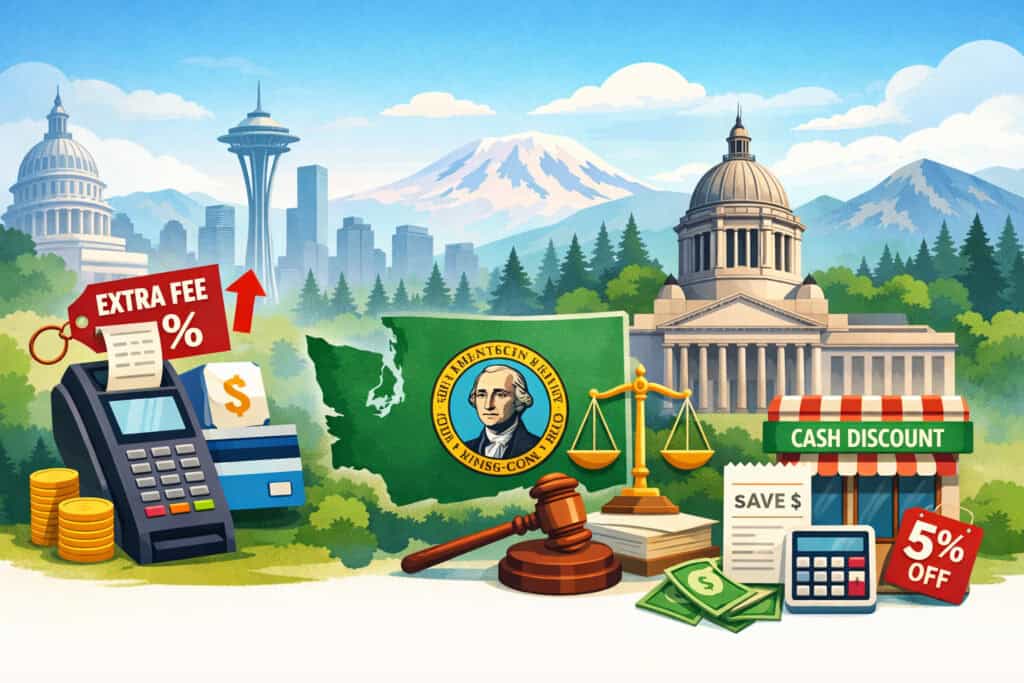
Many small businesses look at surcharging or cash-discount programs to offset processing costs. This can be done, but it must be done carefully. Card networks require specific disclosures, and there are rules about caps and where surcharges can be applied.
Visa’s merchant guidance emphasizes that merchants who surcharge must follow disclosure and other requirements. Mastercard likewise outlines surcharge rules, including caps and disclosure expectations, and advises merchants to consult their acquirer for detailed requirements.
From an operational perspective, your payment processing solutions must support whichever approach you choose with correct receipt formatting, signage requirements, and configuration that distinguishes credit vs. debit when required.
A frequent failure mode is a “DIY surcharge” that confuses customers, triggers complaints, or violates network rules because the disclosures were incomplete.
Also remember the tax and accounting side. Washington guidance in administrative code highlights that credit card service fees charged to sellers are part of the seller’s cost of doing business. That doesn’t mean you can’t structure pricing strategies, but it does mean you should treat these fees correctly in your bookkeeping and pricing decisions.
If you’re considering surcharging, consult your payments provider and your tax professional so your payment processing solutions are configured in a compliant, customer-friendly way.
A safer path for many customer-facing businesses is to optimize costs through pricing transparency, menu/service pricing updates, and choosing the right interchange categories and hardware—rather than introducing a surcharge experience that customers may dislike.
Still, when done properly, modern payment processing solutions can support compliant surcharge or cash-discount models with automated disclosures and consistent receipts.
Security, PCI, and data privacy expectations for modern processing
Security is no longer just an IT concern—it’s a revenue concern. Fraud, account takeovers, and data exposure can damage trust quickly. Good payment processing solutions reduce your risk through secure design, not through complicated rules your staff must memorize.
At the center of card security is PCI DSS (Payment Card Industry Data Security Standard). While PCI requirements vary depending on how you accept cards, the core principle is consistent: limit exposure of cardholder data, use secure systems, and follow validated procedures.
The best payment processing solutions keep sensitive data out of your environment through tokenization and certified hardware—so you’re not storing raw card numbers.
Washington also has legal obligations related to personal information. State law outlines breach notification expectations for businesses that own or license personal information of Washington residents.
Even if a processor handles card data, you may still store customer names, emails, phone numbers, addresses, or purchase history. Your payment stack should include access controls, strong passwords/2FA, staff role permissions, and vendor management procedures.
A real-world example: a Pilates studio runs memberships and stores customer contact information and cards-on-file. Strong payment processing solutions tokenize card details, limit staff access, and provide audit logs for refunds and account changes. This reduces both fraud risk and the operational mess that comes from “everyone shares the admin password.”
Security is also about dispute reduction. Clear digital receipts, transparent refund policies, and customer communication flows (order confirmations, delivery notifications, cancellation confirmations) reduce chargebacks. The right payment processing solutions include these tools because prevention is cheaper than fighting disputes later.
Chargebacks, fraud prevention, and dispute management that actually works
Chargebacks are not just a fee—they are a signal. They can indicate confusing descriptors on statements, unclear refund policies, delivery issues, or true fraud. In Washington, where many small businesses sell experiences (events, tourism, bookings) or online goods, dispute prevention should be built into your process.
Effective payment processing solutions provide layered protection:
- Front-end friction where it matters: Address verification, CVV checks, device fingerprinting, and risk scoring for online sales help filter suspicious transactions. For high-risk orders, you can require signature on delivery or hold fulfillment until verification.
- Clear policies and communication: The easiest chargebacks to win are the ones you never receive. Send receipts automatically. For service businesses, use signed estimates and proof of completion. For subscription businesses, send renewal reminders and easy cancellation confirmations.
- Descriptor management: Customers often dispute charges they don’t recognize. A processor that lets you manage statement descriptors reduces “friendly fraud.” Good payment processing solutions make this easy.
- Dispute workflows: When disputes happen, time matters. Your provider should offer templates, evidence checklists, and automated retrieval of receipts, customer communications, tracking numbers, and refund logs.
Example: a Vancouver-area ecommerce seller ships outdoor gear. During peak season, fraud attempts rise. With the right payment processing solutions, the seller uses fraud scoring to block risky transactions, requires signature for high-ticket shipments, and responds to disputes with automated evidence packets. The result is fewer chargebacks, lower fraud loss, and better approval rates on legitimate orders.
Industry-specific payment processing solutions for Washington small businesses
Different industries need different features—this is where many providers overpromise. The most valuable payment processing solutions are industry-native, meaning they match your workflows instead of forcing you to adapt.
Restaurants and cafés need fast checkout, tips, split tender, offline mode, and integrations with kitchen workflows. Look for terminals that support tap-to-pay, and software that reduces voids and manual discounts through clean modifiers and staff permissions.
Retail and specialty shops need barcode scanning, inventory sync, returns management, customer profiles, and gift cards/loyalty. If you sell across multiple channels, your payment processing solutions should unify in-store and online catalog and pricing.
Professional services (legal, accounting, consulting) often need invoicing, scheduled payments, and ACH options for larger invoices. A clean, branded payment link can improve invoice collection speed.
Home services and contractors need deposits, progress billing, mobile acceptance, and the ability to attach estimates, photos, and signed approvals. Great payment processing solutions reduce “I thought the deposit was refundable” misunderstandings by embedding clear terms into the payment flow.
Wellness and personal care (salons, spas, fitness) benefit from online booking, memberships, no-show fees, and stored payment methods with consent. The right system should also handle gratuities cleanly.
If you choose payment processing solutions that match your industry, your staff training becomes easier, transactions become faster, and reporting becomes more accurate—because the system reflects how you actually operate.
Integrations: accounting, ecommerce platforms, and operational tooling
Payments don’t exist in isolation. They touch your bookkeeping, inventory, payroll, taxes, and customer support. When you evaluate payment processing solutions, integrations should be treated as first-class requirements.
- Accounting integration: You want deposits, fees, refunds, and chargebacks to map cleanly into your ledger. Without this, you’ll waste hours reconciling. Strong systems export detailed transaction-level data and also provide deposit summaries that match bank deposits exactly.
- Ecommerce integration: If you use a hosted storefront or booking platform, confirm your processor supports it natively or via a secure gateway. Poor integrations can lead to double entry, mismatched refunds, or inconsistent tax calculations.
- CRM and marketing: Customer profiles and purchase history help you run loyalty programs, targeted offers, and membership retention strategies. Good payment processing solutions let you segment customers and understand lifetime value.
- Operational reporting: For multi-location businesses, consolidated reporting with location-level breakdowns helps you spot trends. For seasonal businesses, you want year-over-year comparisons to forecast staffing and inventory.
Example: a small chain with locations in Bellevue and Redmond wants unified reporting and consistent pricing. With integrated payment processing solutions, they can see sales by location, time of day, and product category, and they can reconcile deposits without spreadsheets. That’s not just convenience—it’s management leverage.
Managing cash flow: funding timelines, reserves, and smarter settlement strategies
Cash flow is the lifeblood of small businesses. Even profitable companies can struggle if funds arrive late or unpredictably. Strong payment processing solutions help you forecast funding and avoid surprises.
- Funding speed: Some providers offer next-day funding, while others take longer depending on risk, transaction type, and bank relationships. Your contract should clearly explain cut-off times, weekend/holiday behavior, and how refunds affect net deposits.
- Holds and reserves: Certain business models (high ticket, delayed delivery, high refund rates) can trigger rolling reserves or holds. Transparent payment processing solutions communicate risk triggers upfront and help you reduce risk through better documentation, shipping practices, and customer communication.
- Split settlements: If you manage multiple revenue streams—like classes plus retail—some systems allow clearer categorization so reporting and forecasting are easier.
- Payout visibility: The best platforms offer deposit tracking dashboards that show which transactions are included in each payout, what fees were deducted, and what exceptions exist. This reduces time spent calling support and gives owners confidence.
A Washington example: an events company collects ticket revenue months before an event. If refunds spike or disputes increase, processors may tighten risk controls.
Future-proof payment processing solutions for this model include clear refund policies, delivery proof for digital tickets, and strong customer support logs to minimize disputes. That operational maturity can directly improve funding stability.
Compliance touchpoints: taxes, receipts, and marketplace sales
Beyond card rules and security, businesses must align payments with tax collection and recordkeeping. Washington’s Department of Revenue provides guidance on marketplace facilitators and liability relief conditions, which matters if you sell through marketplaces or operate platform-like models.
If you sell both directly and via marketplaces, your reporting must distinguish channel sales correctly so you don’t double-count or misreport taxable amounts.
Receipts and record retention also matter for dispute defense and audit readiness. Payment processing solutions should produce itemized receipts, tax fields, refund logs, and employee action logs (voids, discounts, overrides).
For services, attaching invoices, signed estimates, and proof of completion to payment records makes disputes easier to resolve.
Also keep an eye on evolving industry changes that could affect acceptance decisions and costs. Recent reporting has highlighted changes and legal dynamics around card acceptance rules and fee pressures, which can influence how merchants think about premium cards and cost management.
The practical implication: choose payment processing solutions that give you flexibility—transparent reporting, pricing clarity, and the ability to adapt policies without re-platforming.
Future predictions: where payment processing is heading in the next 2–5 years
The next wave of change won’t be just “new payment methods.” It will be deeper: risk, identity, real-time settlement expectations, and cost transparency. Smart payment processing solutions will evolve in several key directions.
- Tap-to-pay everywhere: Phone-based tap-to-pay is expanding, reducing reliance on dedicated hardware for some use cases. This benefits pop-ups, mobile services, and micro-merchants who want low overhead while still offering a modern checkout.
- Real-time expectations: Customers and businesses increasingly expect faster settlement, instant refunds, and real-time balance visibility. While card rails have constraints, payment providers are building faster payout options and smarter cash flow tools on top of existing networks.
- AI-driven fraud and dispute prevention: Fraud tools will become more predictive and automated. Instead of static rules, systems will learn customer patterns and flag anomalies. Businesses using advanced payment processing solutions will see fewer false declines and better approval rates.
- Tokenization and credential management: Card-on-file will become more secure and more portable through network tokenization and credential updating. Subscription and membership businesses will benefit from fewer failed renewals and reduced fraud exposure.
- Cost and transparency pressure: Merchants continue to scrutinize fees and acceptance rules. As competitive pressure grows, providers that offer transparent, auditable pricing and tools to manage acceptance costs will win. The “future-proof” move is choosing payment processing solutions with clear reporting and flexible configuration, not just a short-term rate discount.
FAQs
Q.1: What are the best payment processing solutions for a small retail shop in Washington?
Answer: The best payment processing solutions for a Washington retail shop are the ones that reduce checkout friction, support modern payment methods, and simplify inventory and returns.
Start with a POS that supports tap-to-pay and mobile wallets, because faster checkout improves conversion and keeps lines moving. Next, prioritize inventory sync, barcode scanning, and clear refund workflows—returns are where many retailers lose time and money.
From a cost perspective, focus less on advertised rates and more on pricing transparency. Ask for interchange-plus style quotes or at least a full breakdown of monthly platform fees, per-transaction fees, and chargeback fees.
The “best” solution is often the one you can audit and understand. If you sell online too, your payment processing solutions should unify customer profiles and let customers return online purchases in-store without confusion.
Also pay attention to security and staff controls. Role-based permissions reduce internal errors and shrink risk. Finally, choose a provider with responsive support—retail problems happen during business hours, and downtime costs real money.
If you need gift cards, loyalty, or customer marketing, ensure those tools are native or integrate cleanly so you don’t end up juggling multiple systems.
Q.2: Can Washington small businesses add a credit card surcharge, and what do they need to do?
Answer: Many small businesses explore surcharging to offset costs, but it must be done with strict attention to card-network requirements and proper customer disclosure.
Visa’s guidance indicates that merchants who surcharge must follow specific requirements such as consumer disclosures and other criteria. Mastercard also publishes surcharge rules and points merchants to their acquirer for detailed requirements, including caps and disclosure expectations.
The practical answer is: your ability to surcharge depends on compliant configuration and communication. Your payment processing solutions should support surcharging in a way that automatically applies the correct logic, prints proper receipts, and keeps signage/disclosures consistent.
DIY approaches—like manually adding a “fee” line—can backfire if customers feel surprised or if requirements aren’t met.
If you’re considering surcharging, treat it as a customer-experience decision as much as a financial one. In some industries, customers accept it; in others, it hurts conversion.
Many businesses decide to optimize costs through pricing strategy and operational efficiency instead. If you proceed, work closely with your processor so your payment processing solutions are configured correctly and your disclosures are aligned with network rules.
Q.3: What security and privacy responsibilities do small businesses have when accepting card payments?
Answer: Even if you use modern payment processing solutions, you still share responsibility for protecting customer data and maintaining secure operations. Card security is guided by PCI DSS, which affects how you accept and store card data.
The safest setups minimize your exposure through certified terminals and tokenization, keeping raw card numbers out of your systems.
On the privacy side, Washington law addresses breach notification for businesses that own or license personal information of Washington residents, which can apply if you store customer contact details or other personal data.
This means your responsibilities go beyond the card swipe. You should secure admin accounts with strong passwords and multi-factor authentication, use role-based permissions, and limit access to customer information.
Operationally, the best defense is good tooling plus disciplined habits: restrict who can issue refunds, track voids and discounts, and keep software updated. Choose payment processing solutions that include audit logs and secure user management.
Also assess vendors: if you use booking tools, loyalty systems, or marketing plugins, verify how they handle data. Security isn’t only a compliance checkbox—it’s part of maintaining trust and preventing the costly disruption of fraud or a data incident.
Q.4: How can Washington small businesses reduce chargebacks and fraud without hurting sales?
Answer: The best strategy is prevention that doesn’t create unnecessary friction for legitimate customers. Strong payment processing solutions balance approval rates with protection using layered controls.
For online sales, use address verification, CVV checks, device signals, and risk scoring. Instead of blocking everything, apply “step-up” verification only to high-risk orders—like requiring signature delivery on expensive shipments or confirming identity on unusual purchases.
Chargebacks are often driven by confusion rather than true fraud. Reduce that by sending clear receipts, using recognizable statement descriptors, and making your refund policy easy to find.
For service businesses, collect written approvals, document work completion, and keep communication logs. For subscriptions, send renewal reminders and cancellation confirmations. These steps turn many potential disputes into simple customer service interactions.
When disputes do happen, speed matters. Choose payment processing solutions with dispute dashboards and evidence tools so you can respond quickly with receipts, policies, delivery proof, and communication history.
Over time, track patterns: which products, customer segments, or marketing channels produce the most disputes. That feedback loop helps you adjust operations and reduce fraud without sacrificing conversion.
Q.5: Do marketplace sales and online platforms change tax and reporting requirements in Washington?
Answer: Yes—selling through marketplaces and platforms can change who collects and remits retail sales tax and how liability is assigned. Washington’s Department of Revenue provides guidance on marketplace facilitators and related conditions that can affect liability relief and reporting responsibilities.
If you sell directly and through marketplaces, you need clean records that separate those channels so you don’t double-count taxable sales or misstate revenue.
This is where integrated payment processing solutions matter. You want your sales data and payouts to align with channel reporting, tax settings, and accounting exports.
For example, marketplace payouts may net out fees and refunds differently than your direct ecommerce store. If you don’t track that correctly, reconciliation becomes painful and errors become more likely.
The practical approach: configure your ecommerce platform and accounting system to map each channel’s sales, refunds, and fees to distinct categories. Use item-level receipts and tax fields where possible.
If you operate a platform-like business (multiple sellers or service providers), ensure your provider can support split payments and proper reporting. In these models, the “best” payment processing solutions are the ones that keep compliance and reporting clean as you scale.
Q.6: What should a Washington small business ask a payment provider before signing a contract?
Answer: Before signing, treat provider evaluation like hiring a core operations partner. Ask for a full pricing breakdown—including markup, monthly fees, gateway/platform costs, PCI-related charges, and chargeback fees—so you can calculate real effective cost, not just a headline rate. Ask whether pricing is interchange-plus or tiered and request a comparison based on recent statements.
Next, ask about funding: deposit timeline, cut-off times, weekend/holiday behavior, and what triggers holds or reserves. Then ask about support: availability, response times, and escalation paths. Great payment processing solutions are only great when you can get help during a real outage or urgent dispute.
Also ask about compliance features: surcharging support and disclosure tools (if you plan to surcharge), security controls, tokenization, user permissions, audit logs, and device management.
For ecommerce, ask about fraud tools, chargeback support, and checkout integrations. For omnichannel businesses, confirm that payment processing solutions unify refunds, customer profiles, and reporting across in-person and online sales.
Finally, ask about contract flexibility: term length, early termination, hardware lease terms (avoid leases in most cases), and what happens if you add locations or want to switch platforms. The best provider won’t dodge these questions—they’ll answer them clearly.
Conclusion
Choosing the right payment processing solutions is one of the most important operational decisions a Washington small business can make. It impacts revenue (conversion and approval rates), cost (fees and operational time), risk (fraud, chargebacks, compliance), and customer experience (speed, convenience, trust).
The winning approach is not chasing the lowest advertised rate. It’s selecting a solution that fits your business model, integrates with your tools, and gives you transparent control over pricing, reporting, and security.
Start by mapping how you get paid today: in-person, online, invoices, subscriptions, and marketplaces. Then choose payment processing solutions that support those channels in a unified way.
Demand pricing clarity and statement-level comparisons. Put security and dispute prevention into your workflow, not just your policy manual. And configure your reporting so deposits, fees, and refunds reconcile cleanly.
Payments will keep evolving—tap-to-pay expansion, smarter fraud tools, real-time expectations, and ongoing pressure for transparency and cost control.
Businesses that invest in adaptable, well-integrated payment processing solutions will be able to respond quickly, protect margins, and deliver the fast, modern checkout experience customers increasingly expect.